
Dear Me,
My dear little Lisa, I am letting you know that you deserved better treatment. You deserved better. You deserved to be held, cuddled, loved, and treated like you have value and appreciation. You deserved to feel unconditional love, to feel accepted, to be acknowledged, to feel adored, to feel appreciated, to experience healthy affection and admiration, to feel approval, to feel that your mother / father / siblings *get you* – that they are attuned to you. You deserved to feel seen and heard.
Instead, you grew up feeling judged, guilty and shamed for being who you are, that you’re not good enough. You grew up feeling responsible for everyone else’s feelings; you contorted yourself so that others wouldn’t feel upset because you always thought it was your fault. You grew up never feeling understood. All this plus the other abuses caused a LOT of damage. What you went through caused so much unnecessary pain and suffering.
It seems your mom was just too busy and distracted with her many responsibilities [she had 6 kids after all!] As you learned later that for many reasons she didn’t have the time nor the wherewithal to be attuned to you and what you desperately needed from her. You ended up feeling and believing you were a nuisance, annoying, in the way, too needy and unloved and especially without value and worth. There was no one there to supply the nurturing you needed. I know you’re not blaming her – she didn’t know better either.
I am so sorry that you felt this way for soooo long, way too long. Too long that it became a core belief and a mindset that deeply impacted your way of being and how you showed up in life. I’m sorry that you felt you had to hide, to play and be small, that you weren’t appreciated for your sparkle and valued for who you are. Instead, you felt ashamed of yourself. You felt guilty for things you did that were symptoms of the complex trauma you were experiencing. You even took on guilt and shame that didn’t belong to you. Your nervous was just too sensitive. I am so sorry that you carried this for all these years, for decades.
You are not the problem. You are not at fault. You deserve to feel unconditional love. You deserve to be and feel supported. And it’s ok and good that you seek out those who will provide this for you. I am here to tell you that your feelings matter.
It’s not your fault that your parents, due to their own childhood experiences, weren’t able to provide the kind of parenting that would have healed you and made you feel safe and protected. I’m sorry that instead you were criticized for making mistakes. Severe punishment would ensue. And that you read it as shame and guilt for just existing. You read it that they were ashamed and embarrassed of you. Your poor nervous system.
Of course with adult wisdom, in looking back you understand it all now. But don’t forget you were a little girl, with little girl needs that weren’t being met. You were trying to navigate a world that had shown itself to be scary and unsafe because of what your brothers had done to you and because your mother wasn’t attuned to your fears, because she wasn’t able to be fully present and console you and assure you of safety and protection. All this piled onto an undeserving little body and a highly sensitive nervous system created your insecurities.
I really feel for you my dear little one.
It wasn’t your fault.
I am so sorry that you experienced this and that now as an adult you must do the work to heal from the scars all this created.
I am here to be with you, to hold you and love you as you never felt. You deserve to feel unconditional love. I know that you need to grieve all this. I’m here to hold you.
Yes, as an adult you understand your parents and see and accept their imperfections. This is good. However, it is important to your healing that you acknowledge how you felt and what you suffered because everyone’s imperfections. And as an adult you’ve acknowledged and own that your unhealed childhood wounds were passed on down to your two sons too. I’m proud of you for healing this much and being self-aware enough. I am proud of you for being as transparent as possible in our healing journey so they too can understand themselves and you better.
It is time to release this unwarranted guilt and remember that all this damage resulted from Adam and Eve’s stupid decision. They passed on this imperfection to their children and on it went down to me and little you.
People don’t know what they don’t know – yet it is each one’s responsibility and obligation to become aware so their toxic behaviour doesn’t keep getting passed onto others.
It wasn’t your fault. Remember that.
It wasn’t your fault.
Your existence matters. God believes you are valuable, that you are worthy. He is there for you and is with you. Please remember where this imperfect and self condemnation comes from – it’s not from Him.
Please keep on letting your light shine. Keep helping fellow childhood trauma survivors see and feel that they are not alone. Please be accepting of yourself and others’ imperfections, knowing that most are trying to do their best. And that there are those who choose denial, who refuse to learn, grow, be open to self awareness – that is on them, not you – these ones be careful of.
Please keep recovering from your childhood trauma so that the detox continues, and the projection stops with you.
I think you’re doing great! So proud of the work you’re doing. It is HARD work and I believe you made the best decision – to heal. The sense of freedom that results is so worth it!
I love you, little Lisa. I am so proud of you. 😊
Lisa B Hilton is an Advanced Certified Trauma Recovery Coach who has lived experience. Through coaching she supports fellow adults transform their travesty into triumph. Please read her blog: Is Trauma Recovery Coaching Right for You? and reach out to her if you feel this modality of Trauma Recovery Coaching will be a good fit for you. Thank you.
Why did you let it happen?
In the past this question was either thought of or asked of one who survived sexual assault or sexual abuse. Perhaps the victim/survivor may have even asked themself the same question. Now it is offensive. It comes from a victim-shaming and victim-blaming mindset. Fortunately, society has come a long way. We have come to understand that in Intimate Partner Violence and child abuse cases, usually other abuses happened first, which escalated to physical violence. This pattern of behaviour is not much different when it comes to sibling sexual abuse [SSA]
Many chalk up sexual activity between siblings as normal curiosity, or harmless sexual exploration. Depending on the age [chronological and emotional], the frequency and the intent, this may be true. Yet, sibling sexual activity that goes beyond mere curiosity is more common that many realize. If one of them feels victimized, this can be traumatizing. The impact of SSA is equal to if not greater than other forms of sexual abuse. What is not usually considered is what went on between these siblings before the sexual activity.
This blog sheds light on the other abuses that may have laid the foundation.
When it comes to SSA I have not heard of cases where a sibling randomly starts touching another sibling’s private areas who are beyond the *exploring* developmental stage. Depending on the ages of the two, there are countless examples where coercion or trickery in the guise of games, experimenting, promises of toys/money/candy, etc., were used. These all duped the other sibling into complying.
Questions surface: How often were the siblings left alone? What about an older sibling’s *authority*? Was there emotional abuse like tattling, ridicule, belittling, etc, or threats of physical harm? What about physical abuse amongst the siblings? How often was there hitting, punching, pushing, slapping or even tickling? What about screaming, yelling or name-calling?
Emotional abuse and or physical abuse or threats of such can be used to lay the foundation for a sibling to submit to the sexual will of the other. One is clearly trying to dominate.
NOTE: When there is oppression and domination of any kind, this is not sibling rivalry, it is sibling abuse. Oppression is in the eyes of the beholder. It is not harmless.
Perhaps the one harmed experienced some physical pleasure of the autonomic nature, and the instigator said things like: “You enjoyed it; you could have stopped if you wanted to.” Words like these result in emotional shame and unwarranted guilt. The instigator shifts the blame away from self onto the other. So, the harmed sibling may continue to acquiesce – suffering deep emotional damage.
Perhaps the harmed sibling was told, ‘Mom or Dad won’t believe you if you tell’ or, “We’ll both get into trouble if you say anything”, adding to that, “if you tell I’ll punch your lights out”. Thus, more responsibility for the abuse is heaped onto the harmed sibling, resulting in further suffering. The pressure to remain silent is undeniable.
Almost always, there is some level of *preparation* that is used. For example, when trickery is used the targeted sibling may not feel manipulated until it’s too late. When physical or emotional abuse is used the one harmed may feel afraid and powerless to say No as shown above. These forms of grooming are designed to get the sibling to submit. Subsequently this creates complicit trauma because the harmed sibling believes they are willing participants. This results in tremendous shame. The psychological damage that ensues is unspeakable. I have listened to many SSA survivors and they share similar experiences – the sexual abuse came with physical and or emotional abuse from the same perpetrating sibling.
Truth is – SSA rarely stands alone as the only abuse the target sibling suffers. As demonstrated, SSA often comes with emotional and or physical abuse. Sibling sexual abuse is complicated, often a clustered abuse. Because of easy access, SSA can go on for months and years. There are stories of brothers who still attempt to rape sisters when both are adults, married with children. This shows that the offending sibling can view the other as an object for self-gratification. In cases like this it is all about power and control.
It is helpful to have the conversation on what’s going on where one sibling crosses the boundaries and disrespects the other.
Let’s be curious about what’s happening behind the scenes. Let’s remain open to the fact that sibling sexual abuse usually comes with emotional and/or physical abuse – a clustered abuse.
Let’s take the shame off the shoulders of the one who was harmed. They didn’t *let it happen*.
Lisa Hilton, CTRC-A, a sibling abuse survivor/thriver, is a Certified Trauma Recovery Coach who supports adult survivors of childhood trauma Transform Travesty into Triumph. She works online with local and international clients.
www.hiltoncoachingconsulting.com.
Where am I in June 2022?
Nearly 4 years into doing the really hard work of trauma recovery, this month I’m looking back. It’s like I was a different person then. Still, I remember the emotional pain and all the thoughts and feelings experienced. For example, I recall the frustration because I felt silenced too often in my life. Therefore, during these last 4 years – I strongly felt the need to purge – to just tell and tell and tell again what I went through, sharing how the traumatizations impacted my life and how the absence of empathy from certain ones caused further pain. My silence was over. It was a way to process and name my experiences, which opened the door to healing, for self-acceptance and self-forgiveness.
Clearly this *telling my story* is a normal and necessary part of trauma recovery. Telling gifts the survivor validation. Telling is healing. Survivors of abuse need to talk, and they need empathetic witnesses to listen. Therefore I often say to others: “I hear you.” Being in this place wasn’t fun at all. I really had no idea what the road to trauma recovery would look like and be like. There were so many unknowns then. I had faith in neuroplasticity though and that is what kept me moving forward.
As a recap, with trauma education, lived experience in childhood/developmental trauma and all that comes with it, this following list is some of what I needed to gain clarity on, or adopt, process, understand and if needed, let go of: trauma bonding, enabling, emotional literacy, emotional intelligence, grooming, FFFF – Fight, Flight, Freeze, Fawn responses, attunement, emotional dysregulation, social anxiety, anxiety, self-awareness, self-acceptance, self-worth, inner peace, spirituality, mindfulness, suicidal ideation, self-compassion, religious abuse, support, listening to understand, receiving and providing Trauma Recovery Coaching and facilitating TRC in 1:1 & Groups, blogging, vlogging, DARVO, workshops, gaslighting, poly-vagal theory, IFS modality, EMDR, EFT, counselling/therapy, advocating, validating, emotional flashbacks, terror, healthy pride, self-love, healthy boundaries, healthy and toxic shame, and more…. I understand myself a whole lot better now and have a more balanced understanding, empathy, and compassion for others and self, plus … a trauma-informed vocabulary. 😊
Childhood Trauma Recovery is an ongoing journey. When ready, the body will bring to the fore some memories to process and detox. This work no longer frightens nor intimidates. The uncomfortable feelings or memories are allowed to be. The more that’s allowed with compassionate curiosity, the faster they leave. I’ve accepted the truth in what we resist persists. Naming what happened makes the trauma lose its power – name it to tame it. What is new now is waking up with emotional flashbacks in the way of dreams. While upsetting I’ve learned to let these feelings exist, appreciate what they’re telling me and understanding this is another way my body is detoxing the trauma.
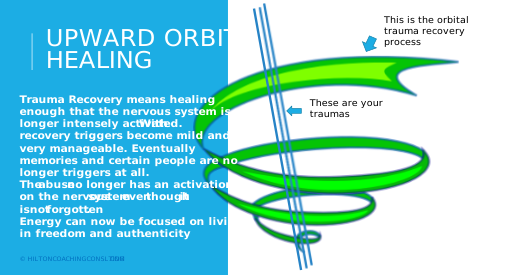 Trauma Recovery Orbit – at the core is / are the traumatizing e-vent[s] and as each orbit takes its turn [this is life happening] and upsetting sit-uations occur, one may go back to similar old feelings and angst. The cool thing is that one is never back at the original pain level. Each trigger felt has less and less impact. Over time trauma memories become benign. Life, as we know it, will always present social/emotional challenges. Yet with the nervous system healing, with the brain rewiring itself, blended with unconditional love, acceptance and support, these challenges are embraced with greater ease. Homeostasis happens quicker. Between each revisit there is more time. Each spiral orbit is bigger, encompassing more time.
For me, processing memories or feelings involves allowing these to surface and be curious about them. Being still, allowing self to sit with and lean into without judgement – this enables accelerated healing. I assess and determine what the memories are. I pray about it, determine what part of the event[s] are mine and what aren’t, then mentally put the shame onto the shoulders of where it rightfully belongs. I own my part and no more. Here is the Accountability stage. I am now at the place where I openly acknowledge and own my part in decisions made. And this no longer feeds the warped and toxic shame monster who’s been following me around for decades. Thankfully this unwarranted / toxic shame has been kicked down to a manageable size. I have gotten used to being in the ventral vagal place – homeostasis.
I do this processing when pleasant feelings arise too. For instance, I didn’t know what it felt like to feel respected and unconditionally loved so whenever I was praised, complimented, or listened to with respect, this was new to me. In the past none of these niceties landed in my heart, all compliments were quickly dismissed. Healing means I’ve learned to sit with the uncomfortableness of the emotions that admiration and respect evoke – I lean into these emotions and feelings. Doing this rewires the brain and allows the nervous system to get used to new healthier emotions and feelings. In time the sluffing off or dismissing the compliments stop. Thankfully with healing, I learn how to get back the feelings of being respected and having self-respect. 😊
Healthy shame was/is behind some good choices too. For instance, I am open to listening to my sons if they want to share what their childhood was like living with me – the behaviours I manifested due to my own unprocessed trauma and while mis-medicated, and all that came with it. It’s painful yet necessary for their own healing. I own my part, I apologize, I listen, cry silently then thank and commend them for their courage to tell. Validation is super important for healing. I have felt the guilt and have apologized. This processing and releasing aids in healing. I recall what it feels like to not receive validation nor witness heartfelt remorse by my perpetrators so I will not do that to others.
Previously, toxic Shame had too much power. I now observe how it impacts others. I see it manifest in so many ways and gone is the urge to explain myself [fight response]. Emotional distance aka healthy boundaries is crucial for my nervous system’s continual healing. While I understand where unhealthy behaviours come from it’s not okay to allow myself to be mistreated – to have others’ shame thrown onto me. I won’t wear it. Healthy Boundaries are super important. Each time I talk to God about it the answer is the same – ‘stay away and let them do their own work; ensure your own peace.’ Shame binds to nearly every feeling if we let it. I refuse to let it have power anymore. And this feels marvelous! Had no idea how liberating it would feel to not carry toxic shame.
This is a big part of the FREEDOM that Trauma Recovery provides. And until I began to have moments of being shackle-free, I had no idea how much life had been lived in chains, had no idea how much I struggled just to survive. I had no idea how much pain I was in nor that shame was usually in the driver’s seat of life. I thought this was normal for everyone. To be able to feel happy emotions and not go into dissociative states is such a triumph. Now THIS is thriving!
Evidence! Recently my eldest son was married. He married overseas and with COVID, it was wiser to be on the Zoom side of the event. To be able to be moved with tears of joy and feel my deep love and pride for him is such a beautiful blessing to experience. To tell him with happy tears how proud I am of him, how much I love him and how happy I am for him was a gift to him and me – he too was moved to tears. I know that a few years ago this couldn’t have happened. To be in the space and place where authenticity and being fully present lives is truly one of the best gifts that trauma recovery has to offer. For those who have never experienced such intense inter and intrapersonal connection, this may sound foreign. Let me say that being able to feel whole within, connected within is something to highly value.
THIS – the authenticity and mindfulness are some of the silver linings that come from all the hard work of self-examination, self-acceptance, leaning into emotions, addressing, learning, transforming, healing, processing, releasing, and gaining confidence – all this has been worth the work. Yes, every single tear, outcry and pain has been worth the effort. I don’t think there is anything more courageous than facing the *demons* of Childhood trauma.
As said in a previous blog, Trauma Recovery is like Emotional Physiotherapy. Childhood Trauma survivors need to learn how to address and accept the traumas [the injuries], develop the right emotional muscles to live life with greater ease, flexibility, movement, and confidence. We need to learn healthful coping strategies for managing whatever lies ahead, instead of doing the avoidance dance. The result? Joy, freedom, authenticity, confidence, connection, healthy relationships, happiness, calm, inner peace, and so much more. Having a peer to peer coaching relationship with a Certified Trauma Recovery Coach [CTRC] provides the right support.
I wish for you, the reader, to continue with your own trauma recovery process. Please don’t give up. The feelings and the amazing life that awaits you is well worth every step taken along the way. You Matter.
If you seek further support in the final leg of your recovery journey, please reach out to me.
I see you, I hear you, I care.
I’m starting to learn about IFS – Internal Family Systems. In looking at my childhood trauma through an IFS lens I’m realizing that many parts are dealing with the same burdens:
- There is too much to do
- There is too much to decide
- There is too much to *be*
By the last bullet I mean that I grew up not feeling loved unconditionally, not fully accepted for who I am – didn’t feel accepted for being me. This resulted in questioning myself – who am I, every day, where do I belong, why can’t I fit in, and with this came a lot of self judgement and self-condemnation. I didn’t know how to simply BE, didn’t know what that felt like. Or maybe that I was just Too Much?
Now…these limiting beliefs – where they more than beliefs? Was I truly being treated this way or was it the shame stemming from childhood that led me to think I was being judged?
Well…..from what I see, from some in what used to be a close circle, there is an unwillingness or an ignorance on how to develop empathy muscles. There is a claiming of understanding but the actions don’t align with the words. This has become more evident after I disclosed about the sexual abuse. Therefore, I’m seeing pain and shame from others’ childhood experiences being projected onto me. The shame that I picked up from the sexual abuse plus this caused a volleying back and forth of the unwarranted shame within the family dynamic. It’s been exhausting.
I will no longer play the shame-volleying game. Shame doesn’t look good on me. It’s not my burden. 😊 Not my circus, not my monkeys.
I recall years ago we had people over for a backyard BBQ and a guest said: “Your family doesn’t appreciate who you are, do they?” I’m sure you can imagine how it felt to be truly seen in that moment. My whole body sighed. I felt so moved by this awareness, by this unsolicited comment.
During my trauma recovery journey, I have stopped the FAWNING. I got tired of contorting myself into being what I felt and thought others wanted. Now, the only approval that matters is God’s, with a healthy balanced sense of self-acceptance, self-approval, self-love and self-appreciation that follows. After so much self-loathing this last sentence sometimes appears and feels a bit self-centered to me. Sigh.
Every child deserves to see their parents’ eyes light up when they enter a room. Every child needs to feel fully welcomed and cherished – feel in their core that their existence matters. They need to feel their parents’ arms around them hugging them and protecting them. They need to feel nurtured and protected. I give the little ones inside me this kind of unconditional love. As their hearts become filled with goodness my outlook becomes less rigid and more loving and gentle. Healthy self-worth helps me to live connected to who I am and how I want to show up in life – who I choose to be. A load has been lifted. Shift happens.
Humility and humanity remind us we all hurt others unknowingly at times. Still, for civility, for connection, for peace and for healing we need to own what we’ve done. In life, it is not a matter of if we will hurt or offend others, it’s a matter of when. So what will we do when that happens – when someone shares that what we’ve said or done is hurtful? What is the healthful and loving way to respond? What will make way for relationship repair?
How many do you know who willingly admit their mistakes? How do you feel when you see someone be humble like this? It can draw you, right?
An unwillingness to listen says a lot about a person. Often a refusal to own and apologize comes from feelings of toxic shame and the fear of being swallowed up by such if there is an admittance. The individual would then be forced to face the unhealthy toxic shame and the self-condemnation that exists within so avoidance becomes a way of life. Being curious, asking questions is a great way to open the door to healing. It’s a way to kick the shame monster down to size – for all parties involved.
Unhealthy communication is a choice.
Avoidance is a choice.
Ignorance is a choice.
Feeling emotions is a choice.
Many don’t understand that childhood trauma survivors can’t have it both ways. Either the body is allowed to experience emotions – all emotions – or it is not. Period. There is no cherry picking of what the body can do re: emotions. The body cannot distinguish between pleasant and unpleasant emotions. To the body and nervous system all emotions are sensations, energy. It doesn’t label any as good or bad. So, when an individual forces self to stop feeling *unpleasant* emotions, the body has to dissociate, to disconnect from ALL emotions. As a result, the body cannot feel the *pleasant* emotions either.
It’s really that simple and that complicated.
Therefore, nearly all childhood trauma survivors have fears and challenges connecting to their feelings and emotions. Doing this work is scary and triggering. The words UNSAFE flash before the eyes like huge neon signs. With the right support these ones can learn to feel emotions little by little – gently dipping the toe in. I have memories of being made fun of because of my feelings and other times my feelings were used against me – to manipulate me, to dominate me, to gaslight me. It wasn’t safe.
Yes, trauma recovery requires safety. “Safety is defined by feeling safe and not simply removal of threat.” – Stephen Porges.
The question is – is it safe for me to be in my own power? Is it safe for you to be in your own power? Is it safe to be around you, around me? Is it safe to simply BE?
Where I stand today, May 18, 2022, the answer is a resounded loud YES!!! It feels good to experience autonomy, to experience and live in my own free will. I do not need others’ approval to live fully. I accept me as I am, I love me as I am and I am convinced that God loves me as I am. 😊 I am happy to be me.
I also accept others for the way they are too. If needed, I can love certain ones from afar to maintain my own sense of inner safety, without guilt. This is self-regulation for me.
As a Certified Trauma Recovery Coach I am in my own journey of healing. I am also trained to support others in theirs. It is my passion to support childhood trauma survivors transform their travesty into triumph.
You are not alone. 😊
Sending love and acceptance to you all.
Why don’t you just pray about it? ** Possible Trigger Warning
The quick reply I’d give is: What makes you think I don’t?
The number of times this question is asked by persons of faith to survivors of child abuse [childhood trauma] is impossible to count. While those who ask this question are usually sincere and have a fairly decent motive, the fact remains that this question reveals more about the questioner than the questionee. For example, this person may…
- need more education re the real and lifelong physical and emotional injuries that result from child abuse – aka – asked out of ignorance
- be avoiding addressing his/her own childhood trauma
- feel uncomfortable watching someone do their work for it may evoke own feelings that have been ignored or denied
- be afraid of these possible awakened feelings
- carry own underlying shame due to the past
- feel powerless to help or feel overwhelmed by it all, said out of shame or frustration
- be afraid to go to therapy for self for whatever reason[s]
While none of these points are bad nor wrong, if you, the reader, have ever felt this way towards someone who is struggling, then be rest assured you are not alone. It is important to note that although well-intentioned, this question lands on an abuse survivor as victim-shaming and guilt-tripping dialogue. It is not helpful.
Or perhaps you, the reader, have said such things to yourself? If so, I’ve been there too. Saying things like this is dismissive, disrespectful re the level of your own pain and literally hurtful to your physiology. Oddly enough it is a type of self-gaslighting.
Not saying that praying about a matter of concern is wrong. However, prayer can be used to avoid doing the hard work of healing/recovering from various abuses. It is important to be clear – using prayer in this way is a type of Avoidance behaviour. This is called SPRITUAL BYPASSING. To bypass something means to go around it, jump over it, etc. It is the opposite of going through it and dealing with it head on. While bypassing the work of trauma recovery is appealing, it does NOT help the individual to really *get over* the issue. The only way one can release [get over] the pain of child abuse is to go through it – experience the feelings and detox from them hopefully with the support of professionally trained individuals. Only then will the undesirable feelings stop surfacing.
You have to feel it to heal it.
What is Spiritual Bypassing?
Spiritual Bypassing is using God, any religion or belief system, Amulets, Spiritism, New Age Mysticism, etc., including the latest trend of toxic positivity to “just think positive thoughts and positivity will come your way” – anything – to NOT deal with the pain from the past. For those of you who pray and read/study the Bible – have you noticed that when you pray, you may get some relief, but it doesn’t last? The past keeps coming up repeatedly, right? This verifies that childhood trauma is not just a brain memory, it is also stored in the body, the tissues, the nervous system, at a cellular level. This explains why the initial relief isn’t permanent and that medical intervention is needed.
Ignorance assumes that the child abuse survivor has a spiritual problem. The level of faith doesn’t have the correlation to childhood trauma as most think. Emotional pain is way more complicated than that. The truth is – feelings buried are buried alive and they will always find a way to surface.
Would you say to someone who has survived a serious car accident, spent months in traction healing, and now can potentially live a full / active life – that they should not bother going to rehab nor that they should just pray about it and thereby wait for God to do the healing / recovery work? I hope your answer is NO because that really isn’t sound thinking, is it? Rather you would encourage this individual to go to rehab, do the exercises, build up muscle tone again, etc. so that s/he could have mobility and live as healthfully as possible, right? Yes!! And this is what it’s like doing the necessary work of healing from childhood trauma. Survivors of various childhood traumatizations need trauma-informed professional medical help to live life as best they can and accomplish what they want today. They need emotional physiotherapy to develop strong *coping muscles* and healthy strategies to manage whatever is needed to thrive, not just survive.
Most childhood trauma survivors have felt stuck, frustrated, mentally foggy, isolated, emotionally dysregulated, dissociated, have social anxiety, carry unwarranted guilt and shame, deal with poor health, some are in severe mental and emotional anguish, etc., all stemming from the child abuse/neglect. Therefore, it is not wrong, nor a lack of faith nor a sign of poor spirituality or poor decision-making to want and need to recover from the damaging results of childhood trauma sooner rather than later. God is labelled as a happy God. He wants us to be happy and thrive, now. Unprocessed childhood trauma impedes this.
So please, let’s stop assuming, judging, criticizing, finger-pointing, shame-throwing and fear-projecting onto the victims of childhood trauma. Haven’t they suffered enough? A suggestion – if you want to use the Bible please do so as it is intended – as a mirror.
My ask is that others who haven’t done their own trauma recovery work not impose their opinions onto childhood trauma survivors who are. Please be careful of what you’re really saying, how it’s landing and … be aware of where these opinions stem from. One who is in distress doesn’t necessarily need spiritual counselling. They need comfort instead. Timing is everything.
Together we can create safe spaces for those who choose to work through their childhood trauma.
**Trigger Warning – some religious beliefs are mentioned. Normally I do not blend trauma recovery with religion because there are many who’ve been traumatized by religious and spiritual abuse. I remain sensitive to this. If this has triggered you, please resource yourself healthily or email me.
If any of the 7 points above hit a nerve, perhaps your body is telling you something. If comfortable, click on the question: Is Trauma Recovery Coaching Right for Me? If you’ve done a measure of therapy already and are seeking further support, reach out to me and let’s have a chat.
Throughout my teen years and early adulthood, I carried a fragmented memory—something that happened when I was about four or five, something I didn’t have language for at the time. It involved a sibling. It lived in my body before it had words.
Later, when I finally learned the term molestation, that memory clicked into place. It had a name.
Years later, at 29, I was doing a roleplay exercise where I spoke to my “father”—addressing the unspoken pain. I asked him why he spent so much time warning us about stranger danger, yet failed to protect me from his own son. The danger wasn’t outside. It lived inside our home.
A few weeks after that, I confronted my brother. I asked him if he remembered what happened. He nodded yes.
His response? “I’m sorry this still upsets you.”
It wasn’t accountability. It wasn’t remorse. It was deflection. It was blame-shifting.
Then he brought up something else—another event I hadn’t consciously remembered. He asked if I recalled the time when he hung me upside down out of an upstairs window. I didn’t—at least, not visually. But decades later, my nervous system would remember.
At the time, I didn’t fully grasp what was missing in his reaction. But now I see it: he didn’t understand the seriousness, the criminal nature, or the lasting physiological damage of what he’d done. He didn’t comprehend the boundary that was crossed—how that violation would echo through my developing brain, nervous system and sense of self. Not understanding as a child is one thing. But as an adult, it becomes a choice—and that choice causes harm.
His apology then was hollow. There was no grief in his voice. No recognition of the harm, no act of repair. No weight. Just words.
How does a toddler grow up feeling safe when she has to eat dinner each night beside her abuser?
How does a child build trust when her pain is minimized, when the grownups she turns to fail to protect her?
The truth is: she doesn’t.
And that’s the journey I’ve been on ever since—navigating life with wounds I didn’t ask for, which impacted everything that I did and choices I made going forward. Even with this monumental handicap I tried. I tried in school; I tried in life – doing my best to understand my story, to be a good mother, a loving wife, a person my God would be proud of.
It took me years to realize the quiet thread woven through every choice I made:
I never felt safe.
Not in my home. Not in my body. Not in the world.
Part of my healing now is just learning what safe feels like.
Letting it in.
Teaching my body that it no longer has to brace itself.
Learning to welcome calm without mistaking it for danger.
As a child, I was teased relentlessly. Called names meant to humiliate. Mocked. Hit. Shamed. The psychological abuse was ongoing. Home life wasn’t easy. I even attempted to unlive at 15 years old. And when I finally asked for help—when I told my parents about the abusive behaviour (the punching and name calling) —the interventions never touched the root of the abuse.
The message was clear: Lisa’s feelings don’t matter. Lisa doesn’t deserve respect. Lisa doesn’t matter.
But that message isn’t truth.
It was trauma.
And I’m happy to say that I get to write a different one now.
Sibling Abuse: A Wound That Doesn’t Expire
Sibling abuse—whether sexual, emotional, psychological, or physical—leaves deep complex scars that can last a lifetime. Its impact is shaped by many factors: how early it began, how long it lasted, and—perhaps most importantly—whether the survivor received meaningful emotional support. Without that support, the harm compounds.
In my case, the sibling who sexually abused me was 8.5 years older. I was just four.
Was he under 18? Yes.
Did he understand that what he was doing was sexual assault? In 1968, likely not in those terms.
But did he know it was wrong? Yes—because he locked the door.
That memory haunted me for years. I’ve searched for answers that never arrived.
Was he exposed to pornography? Was he abused himself? I don’t know.
What I do know is that a couple of years later, a cousin came to live with us, sibling-like. She was a few years older than me—and she sexually abused me, too.
It’s no surprise I dissociated.
How else can a child survive in a home that’s not emotionally, physically, or psychologically safe?
Where Safety Should Have Been
As we know, abuse of any kind doesn’t happen in a vacuum. Anyone can Google and learn what the factors are that makes fertile soil for sibling abuse of any kind. There are always enablers and enabling circumstances. Things like unaddressed trauma in the caregivers, a patriarchal environment, parental neglect or emotional unavailability, failure to intervene, denial or minimization of situations or events, fear of consequences (shaming punishment), power imbalances, exposure to pornography, emotional illiteracy, and more.
I am aware that decades ago mental health and emotional trauma weren’t part of everyday conversations. Most families didn’t have the resources or understanding to recognize the signs of childhood trauma. Nor was there education for how to offer what parents never received emotionally themselves. As is said, it takes a village to raise a child, but I’ve also learned this: it also takes a village to abuse one.
Unfortunately, the family of origin’s emotional constipation—however unintentional—compounds the trauma.
There was no safety net. I felt. No protective or affectionate gaze. When I looked into others’ eyes, I saw shame, frustration, overwhelm, and judgement. Without the proper emotional education, there was no acknowledgment of harm. I never saw love.
Because of that, I grew up believing I didn’t belong anywhere. The message I received from my experiences was that I wasn’t fully accepted—even in my own family.
Until I began studying trauma, I just assumed something was wrong with me.
A Thousand Tiny Echoes of Abuse
There were other signs, too:
- I struggled in school—socially and academically
- I had difficulty processing what I read and sometimes misheard things.
- I was awkward and painfully shy.
- I believed, with quiet certainty, that I was ugly and unlovable.
That’s what abuse whispers to a child:
You’re unworthy. You’re insignificant. You’re fundamentally wrong. You’re unlovable. It’s all your fault.
Interpersonal trauma including emotional neglect—especially when it happens in childhood—disrupts more than cognition. It affects how we relate, attach, communicate, and trust. The brain’s development is severely impacted. The cumulative effect is staggering.
And still, the biggest truth—the elephant in the room—is this:
I was sexually assaulted by my own siblings.
And it changed me in every way imaginable.
Breaking the Silence—and the Fallout That Followed
In 2019, I shared the truth with the rest of my siblings. I told them what happened. What he did.
What I’d carried. Although he had admitted it to me—and confessed doing something to me that was “reckless” to two of his three wives—he immediately began backpedaling.
He denied it to some and minimized it to others. He twisted the story. Painted me as the villain, as if I were “ruining his life.”
He even wrote: “I shouldn’t have to pay for the rest of my life for one non-malicious act.”
That sentence says everything.
No remorse. No accountability. No understanding of what it means to violate a child’s body, to fracture a family, to carry that wound into every corner of a life.
The Aftershocks
I’ve learned this:
When abusers lose the ability to control their victims physically, they often shift tactics. Psychological manipulation. Denial. DARVO. Grooming others to see them as the “real victim” and to doubt the accuser. Talk about cold-heartedness.
And the shame? It doesn’t just land on the survivor. It becomes part of every family member. And it poisons relationships, corrodes trust, fractures families. His refusal to take responsibility created a ripple effect. And now the rest of his biological family are left sorting through the wreckage. The thing is, who of them is willing to do the work of sorting?
Because when a secret like this comes into the light, it doesn’t just shatter silence.
It shatters illusions. And people don’t always react well when the story they’ve clung to falls apart.
It was difficult to witness the resistance to the truth amongst the siblings. That they just didn’t want to believe me. Rather, they took his side as evidenced by believing his denial and minimizations. They wanted to believe it wasn’t true, so they allowed their ears to be tickled and not cling to the truth. They abandoned me while inviting this abuser brother into their lives and homes to visit. This emotional abandonment is another form of abuse. It hurt worse that the sexual assault.
Owning the Truth, Finding the Light
Spending over five decades hiding the truth fractured me in ways I couldn’t keep living with. The denial, disconnection, and dysfunction became too heavy. That path—the one paved with silence—only leads to self-destruction.
And yet, I understand why people choose it.
Isn’t it easier to pretend it didn’t happen?
To minimize it? Ignore it?
To side with the abuser’s version—because facing the truth means confronting shame, guilt, blame, and powerlessness?
But silence has a cost. And eventually, it comes due. Just because I’ve come to learn that individuals can only meet you where they’re at – at their own capacity, doesn’t mean that how they all responded was right or acceptable. And I will not pretend the abuse never happened ever again. Their comfort, their feelings, are not my responsibility.
When I first disclosed, I received messages from siblings expressing shock, concern, support. They asked how they could help. I gave them all the same answer:
Educate yourself.
On child abuse. On sibling abuse. On DARVO. Learn the pattern. Learn the impact.
With that I hoped. I hoped they would show me—not just with words, but with sustained understanding. Then they’d be able to support me with knowledge and insight, and, above all, with compassion.
But for the most part, that follow-through never came. Not after they asked the abuser brother of it was true…and they chose to believe him.
There’s a familiar family dance when it comes to discomfort:
“If we don’t talk about it, it’ll go away.
If we avoid the tension long enough, maybe everything can go back to normal.”
But that isn’t healing. That’s avoidance. And avoidance silences the survivor. It dishonors the wound. It creates toxicity instead of resolution.
By the time someone finally offered to truly listen, the abandonment had already done its damage. I asked that sibling what they’d be willing to do to help me feel safe. That was in August 2019.
I’m still waiting for a reply.
Yes, a few have reached out since. But their words proved hollow—kind, perhaps, but not connected to empathy or action. It seems they don’t want to do the emotional and self-awareness work.
Because compassion isn’t lip service.
Compassion starts with empathy, which means to suffer with. To feel with. To stay present.
And after years of being gaslit, dismissed, mocked, ignored… my brain and nervous system are still protecting me. They do not feel safe with them. I’ve learned the signs I missed before. Until there is clear, consistent, and courageous effort to repair, I must keep my distance. Their criticism, judgment and somehow making what I’m going through to be about them needs to stop.
Before any relationship can evolve, the elephant in the room must be acknowledged.
There’s a line from Sibling Abuse: Hidden Physical, Emotional, and Sexual Trauma that struck+ me like lightning:
“Emotional abuse, as the child abuse literature states, is more prevalent and potentially even more destructive than other forms of child abuse.”
Emotional neglect doesn’t just hurt—it erodes identity. It teaches you that your existence is too much, or not enough. That who you are is somehow undeserving.
And now, fMRI studies are showing what survivors have always known in their bones: emotional neglect causes damage to the brain that rivals sexual abuse.
The little girl inside still sometimes asks:
Where was my mother? Why didn’t my father protect me?
Was I not lovable enough? Didn’t I matter?
Yes, my mom occasionally scolded a brother or two. But it didn’t stop the abuse. It didn’t make the home safe. And the failure to ensure home was safe and nurturing rang louder than any words.
Trauma experts agree:
The best way to heal childhood trauma is through safe, consistent emotional connection.
Not silence.
Not distance.
Not denial.
And yet—even with all this—I am healing.
I have cried. Prayed. Grieved. Drowned in toxic shame. I’ve stumbled, faltered. I kept picking myself up and kept going.
And I’ve come a long, long way.
I’ve stopped waiting for family to become who I needed. Eventually I learned to let that hope go. I’ve made peace with the idea that they may never understand. This is between them and God.
Instead, I anchor myself to the ones who do:
- Those who have listened without judgment.
- Those who have sat with my tears.
- Those who’ve stayed steady when I’ve felt anything but.
- Those who’ve said, I believe you, and mean it.
They are my blessings.
They are a provision.
They are the answer when I pray for direction—and the reply comes, “Not them. Not now. I am what you need.”
And trust me, I’ve had many very dark moments. I’ve wrestled with monsters and made peace with my past.
I no longer feel unworthy or unlovable.
I don’t carry shame for my wounds or guilt for how others respond to my truth.
Their behaviour is theirs. I choose peace.
I’ve learned that shame often hides behind anger or fear or hurt.
That cruel or dismissive comments and criticism are often propelled by guilt—or ignorance.
And ignorance?
That’s a choice.
Because it’s easier to attack the whistleblower than to face the truth. And I am so tired of being criticized by them.
But I will keep telling my story. I am not ashamed of what happened to me. I am not ashamed of my story. The shame isn’t mine – it’s theirs.
Because I know what it feels like to be the only one in the room carrying the weight of the truth.
And I don’t want other survivors of sibling abuse or childhood trauma to feel as alone as I once did.
I choose to walk beside others as they navigate the winding path toward healing. It is an honor. A sacred trust.
And I want you to know this:
You are not alone in your healing journey.
Thank you for holding space for mine.
Lisa Hilton, CTCP-A, a Trauma & Resilience Specialist, walks along adult survivors of childhood trauma, post therapy, so they can reach their healing goals and live their life joyously shackle free.
Most of us would shudder to ever think that we would enable a predator or an abuser to abuse a child. To enable is defined as:
- To provide the means or opportunity; to make possible, practical, or easy; to cause to operate
- To give legal power, capacity, or sanction to
With this definition would you say that if someone ignores the warnings signs of abuse, or blatantly allows their own child to be used or abused by another person is an enabler? Wouldn’t you agree the answer must be Yes!
For child abuse to stop, one of the biggest things that needs to happen is for others to wake up to what is going on. Educating yourself on Grooming and other ways that child sexual predators operate is imperative and well worth the time and effort. Enabling happens wittingly and unwittingly. The result is equally the same on the victim – the emotional, physical, psychological and brain injuries are the same.
As a society and as neighbours, prevention would include times when an individual knows or suspects abuse or neglect. The thoughts of ‘I don’t want to get involved’, or ‘maybe I’m imagining things’, or ‘I wouldn’t like someone else to call about me’, push aside the protection and safety of the child. According to the above definition, if an adult suspects something wrong and does nothing, this can be classified as enabling. Here in British Columbia, Canada, we have a legal duty to report concerns to a child welfare worker. Calling after hours 1.800.663.9122 gives one the option to report anonymously. So yes, there is a duty to report. The Child, Family and Community Services Act requires “anyone who has reason to believe that a child or youth has been or is likely to be abused or neglected, and that the parent is unwilling or unable to protect the child or youth, must report the suspected abuse or neglect to a child welfare worker.” Sobering, isn’t it?
We know that on September 15, 2021 the Senate Judiciary Committee was investigating the role two FBI agents played that enabled Larry Nassar to keep sexually abusing and molesting female gymnasts. Senator Cory Booker said: “The one saying that rings in my head is the only way for injustice to continue is for good people to do nothing.… It shouldn’t take something to directly happen to us to trigger our empathy and our action.…We are all playing a part in a culture that allows this to happen.”
Senator Blumenthal said some strong words directly to FBI Director, Christopher Wary: “the actions and inactions are totally unacceptable. [italics mine] … These individuals betrayed the core duties that they have of protecting people. They failed to protect young women and girls from abuse.” He also said that the false statements by the two FBI agents “is blood curdling”. The inaction he referred to can be labeled as enabling and it becomes institutional betrayal.
Clearly, enabling abusers to continue strongly incites our sense of justice and we cry out for such. And it is the abused victims who are exhausted, worn down, physically dealing with the aftermath of the sexual abuse, sometimes for the rest of their lives. The victim-shaming and denial and coercion all takes a toll. Aly Raisman, one of the gymnastic athletes who survived the abuse, described how far reaching the aftermath and residual impact of sexual abuse has in her own health, where she spoke to her extreme fatigue, and it led to collapse. It was due to the exhaustion of healing from the trauma. She is not alone. Most, if not all trauma survivors suffer various physical challenges; fatigue and brain fog are very common.
This type of outrage at the egregious actions on the part of the two FBI agents and Larry Nassar and the USGA, USOC and the USPC clearly has ignited outrage regarding the enabling and the cover-up that took place. We all feel this betrayal. As onlookers, we also can experience a certain level of vicarious trauma betrayal, simply by knowing this happened and by watching the legal and judicial proceedings.
Another example of institutional betrayal and enabling is the ongoing news releases on the sexual abuse cover ups within the Catholic Church. Now there are more than 200,000 that the French clergy [in France] have abused since 1950. This is just one ‘Catholic’ country. How many victims in total does this make now? One article stated the church had shown “deep, total and even cruel indifference for years,” by protecting itself rather than the victims of the systemic abuse. It is important to note here that child sexual abuse is not exclusive to the Catholic Church. Sexual predators love religion, all religions. Where else can one find a more submissive target that in an organization where all are taught to be forgiving, to be loving and kind, to be obedient? And time nor space will not permit delving into the atrocities committed against the helpless child victims of the colonization of the indigenous populations via the residential schools in North America and beyond. This will be discussed at another time.
Yes, the opposite of love isn’t hatred, it’s indifference. And this is where the painful betrayal comes from too. The feeling that we don’t matter, that our pain doesn’t matter, our story and what happened to us doesn’t matter. Righteous indignation often arises coupled with the hurt and betrayal. True we cannot undo what has been done. Owning up – being accountable – and doing one’s best to make up or right the wrong may be a stepping stone towards repairing the relationship.
Now let’s think of a domestic situation. If one caregiver of a child does not prevent another parent or adult from verbally, emotionally, physically, or sexually abusing the child, what message does that send to the child? The one adult is enabling or granting permission via inaction. In some areas of the world, it is now an avenue for social services to remove a child/ren from a home when there is domestic violence because of the long-term impact this has on the children – witnessing violence is abuse. So, if witnessing violence is considered abuse how much more so is enabling the abuse? Does this not also cause abuse?
I will not go into the reasons why a parent may not stand up for the child. I am simply giving what is happening a name. We need to call it what it is. Silence on the part of onlookers is enabling, choosing to ignore what is seen or heard is enabling. Not holding the perpetrator nor the institutions accountable is enabling, all which result in another layer of betrayal.
What I’ve found is that it’s not just people who are enablers. The biggest enablers are Denial, Silence, Apathy, Ignorance, Complicity, Indifference, Fear, and Shame. All these are choices that one makes in life. We all have free will. So, choosing to look the other way over facing the truth, choosing to deny what is seen over being open to it, choosing to be apathetic over caring, choosing ignorance and complicity over compassion– these are decisions one can make every single day.
Enabling can show up in subtle ways too. It usually isn’t bold and obvious. That’s why education on enabling is so important. In a home environment, enabling can show up in just being too busy as a parent or caregiver to notice when a child is suffering or is struggling. Enabling can show up when a parent or caregiver is not emotionally intelligent to the feelings of the child/ren or when there is an environment that is emotionally neglectful. Enabling can show up as a lack of attunement in the parent/child relationship. Enabling often happens when the caregiver has not processed his/her own trauma.
Enabling shows up after the victim discloses what happened and those close to the accused/perpetrator maintain the same relationship with the accused and over time, end up ignoring or ostracizing the victim. Pretending the abuse didn’t happen enables the perpetrator to stay in his/her own denial and accountability is never expected. This enabling, this cover-up is extremely painful for the abuse survivor to watch and endure. And it is damaging to the abuser; it impedes their own personal growth.
Let’s go back to the definition of enabling: To provide the means or opportunity; to make possible, practical, or easy; to cause to operate. Enabling, covering up, remaining silent, looking the other way, pretending that what is noticed isn’t happening never helps the victim, never helps in the healing, never supports the building up of the health and well-being of citizens in any nation.
All I ask that that you name what you see, notice this is happening when it happens, trust your gut, and come to the aid of the victim. Being silent never helps the victim. Silence always helps the abuser – it helps the abuser to keep on abusing.
Lisa B Hilton, CTRC, is a Certified Trauma Recovery Coach working with adults who’ve survived childhood trauma. She herself is a childhood trauma survivor. She supports these ones in transforming their travesty into triumph. She coaches clients on a one-to-one basis and in closed group coaching sessions. She is a blogger, an educator on childhood trauma, a consultant. She is a wife, mother, dream supporter and has a passion for supporting people connect to their authentic selves so that they can live life in the freedom they’ve always wanted.
She can be contacted through hiltoncoachingconsulting.com
HAVE YOU EVER BEEN LEFT …..
D
A
N
G
L
I
N
G
?
I have….. many times, literally and metaphorically.
Have you noticed how this impacts your nervous system?
This is a recent epiphany for me – today in fact.
Left Dangling – As a childhood trauma survivor I’ve experienced this on different levels. I’ve addressed many of my traumas, and this new one about dangling surfaced. This is a new realization of what my body and nervous system endured in the past.
Left dangling \ hanging evokes feelings of abandonment, rejection, fear, unworthiness, and confusion. Definitely a sense of powerlessness. One’s sense of justice cries out. It is a tool, when used intentionally, to get the need met for power and control. This happens in private life and in professional life – it can happen in every relationship.
How was I left Dangling, literally? Well…. And here is a Trigger warning:
Before I was 3, brother #2 led me to a 2nd story bedroom and dangled me outside, upside down. He is 8.5 years older than me. I have no recollection of this event. HOWEVER, my nervous system most certainly does.
How do I know this happened?
When I confronted this same brother about memories of something sexual he did to me he said something like: Don’t you remember me hanging you upside down outside M’s window? I thought you’d remember that more than this.
This comment alone says so much about his headspace, his lack of empathy to the assault he subjected me to and was sidestepping towards another trauma he inflicted. Perhaps this one of dangling me outside a 2nd story window impacted him more? Who really knows. True, he was a kid himself…. Still…. I was a toddler. Both incidents were life-altering for me. I have never been the same since.
This soooo makes sense why in July 2018 I had such a physiological response to his religious abuse. I felt absolutely terrorized and frightened out of my mind by him and this experience.
Clearly there is a somatic response to leaving me hanging, dangling. I can see how much that terrifies me. I see now how it showed up in the decisions I’ve made – of my insatiable need to know, to understand so that I have clarity and am not left behind, not left *hanging/dangling*. Confusion itself can be a trigger for me. This fear of dangling, of not having the support I need, the knowledge I believe I need, spurs me on to keep reaching forward until this need is met. My nervous system sees this as a matter of life or death….and it is not something that can be reasoned away, unfortunately – not when I’m feeling that dangling feeling.
In looking back, there are pivotal times in my life where I was left dangling, without support. These were events that were big in my life as a little girl. And when a little girl is left, abandoned emotionally, what message does she receive?
Abuse alone makes one feel isolated and alone. It terrifies. The psychological damage that emotional neglect evokes is more damaging than the physical or sexual abuse itself. The feeling of betrayal is deep…. Deep….. Deep.
When a woman is left *dangling* in relationships that she needs to feel connected, loved, supported and respected…. Wouldn’t she feel pushed into feeling that her existence is in danger, that the next choice is a matter of survival? Especially when there is a literal somatic memory of dangling and powerless to stop it?
It truly is amazing how childhood experiences show up later in life.
Healing requires the conscious brain to acknowledge what the body and nervous system experienced – that the events which evoke these feelings…. Happened. The mind / body connection needs to be and childhood trauma survivors have often developed a disconnect between these two.
I tell my clients – You have to Name it to Tame it.
And as a fellow trauma survivor I too must walk my talk. Trauma recovery requires acknowledgement of what happened [each time I somatically acknowledge an event such as described above I feel as if the wind has been knocked out of me. My body has a physiological response and I need days to recover] Therefore, I must name the experience[s], sit in the feelings that arise and use this as an opportunity for self compassion, self understanding and if needed, self forgiveness. It is not about pointing fingers or assigning blame. After I do this, the unpleasant feelings dissipate and inner peace arrives. These are replaced by feelings of love, acceptance, compassion, appreciation and PEACE! This is what makes trauma recovery worth the work.
I admit, healing is messy. Here I am 3.5 years into the hardest work I’ve ever done. Current life challenges that we all experience always have connections to the past if some parts of the past are unresolved. Detoxing from the past is ongoing. I am not the same person I was 5 years ago and I see it as a good thing.
Feeling some of the pain does not mean one is weak.
Rather it requires tremendous strength and courage to face unknowns or terrorizing and humiliating experiences. Yet you don’t have to relive them.
Having a compassionate witness to sit with, to offer validation, encouragement, support, comfort, and provide some navigating ideas…. All this helps the childhood trauma survivor keep doing the healing work.
We ALL need that one close, heart to heart connection. We ALL need to feel attuned to, to feel validated. THIS is where healing happens. If you have more than one such connection, then please consider yourself blessed.
Life carries on. It is not fun nor fulfilling sitting in the sidelines. Trauma survivors often feel like observers of life instead of participants. They want and need more – to keep moving forward – to keep on climbing. We all are designed to feel and experience joy. We need to feel free, to live the life we love, to feel exhilaration – authenticity. As a childhood trauma survivor, I can confidently say: it’s worth ALL the work.
You are NOT Alone.
THIS is also what I offer my clients. I have lived experience in Childhood Trauma. I get it.
~Compassion
~Acceptance
~Safety
~Attunement
My CASA Method of Coaching
I sit WITH you. I’m here.
This IS MY SUPERPOWER.
To answer this question, it would be helpful to be clear on how therapy and coaching support those who’ve suffered and survived egregious violations.
- Therapy is a necessary component to trauma recovery. Like any serious injury one goes to hospital or trauma centre to make sure the severe injuries are addressed first. Likewise with an emotional injury – one would go to a specialist to address the initial critical wounds of the abuse. This would be a therapist, psychologist, counsellor, psychiatrist, etc. These mental health professionals can diagnose.
- Once this critical situation is addressed the person then leaves the hospital but usually has some sort of physiotherapy so that support is in place for adaptation to living, thus learning the right skills to cope and manage life going forward. This is where Trauma Recovery Coaching [TRC] comes into focus.
- TRC focuses on providing support for current challenges, with a trauma-educated lens by offering healthier coping strategies, healthy communication skills, supporting greater self-awareness and self-compassion, which increases self-confidence and self-worth so that life can be lived in freedom and authenticity. We do not diagnose.
- Interpersonal trauma needs healthy interpersonal relationships to heal. TRC provides that safe place and space for you to experience a healthy relationship where you can begin to trust, to get clear on what happened and its impact in your present life plus re-connecting and re-discovering who you are.
Does this sound like something that would help you? Do you think you are ready for this next step?
First you need to know where you are at now in your healing journey. Have you had some therapy and or have healed to a certain level and reached a point where you could use some extra support in this next phase of trauma recovery? Have you taken your ACEs test? What is your score? https://acestoohigh.com/got-your-ace-score/
How well do you know yourself?
- Are you finding that you are feeling stuck?
- Are caught up in the *doom loop* thinking?
- Do you hold yourself back from making certain decisions?
- Do you find that you’re making the same unhealthy relationship choices? Or would classify yourself as relationship-challenged?
- Do you want to increase your self-esteem?
- Do you find that TRUST is a big challenge for you?
- Are you finding that previous coping strategies are no longer serving you?
- Do you second-guess yourself?
- Do you want to have more self-confidence?
- Are you noticing that you struggle with procrastination or struggle to complete a task/project?
- How is your patience level – with self and others?
- Are you a perfectionist?
- Do you prefer to not be noticed?
- How are your communication skills?
- Do you tend to take on the guilt of a situation even when it is not really your fault?
- Do you think you are just *not good enough*?
- Is there a part of you that believes there is something seriously wrong with you?
- Are you fed up with your life the way it is now and long for a better quality of living – where there is more authenticity and a sense of freedom?
- Have you been diagnosed [through self or a MH professional] that you have Complex PTSD.
If you’ve answered YES to a lot of these questions, then Trauma Recovery Coaching may be the appropriate next step for you at this time.
If you are ready to proceed with a Discovery Call, these questions are very important for you to be clear on so you can feel right that this is the best next step for you.
- What exactly has brought you here at this time? (What outcome or recovery goals are you hoping for if we work together?”)
- What do you hope to get out of a Discovery Call? (Do you have particular questions/concerns or want help figuring out what you should be doing or want to work with me specifically or….?”)
- Why are you looking for help? Not simply what problem you’re looking to solve but WHY? (What does this problem / hoped for solution mean to you?”)
- What objections or concerns do you have? (Maybe there’s none; maybe there’s 30…lay ’em on me”)
- Is there anything about you that feels important for me to be aware of? (Preferred pronouns, ethnicity, cultural background, sexual orientation, spirituality, particular experiences….”)
- How committed and ready are you to do the hard work at healing from your trauma?
- What do you want to know about me [that is not on my web site] that will help you decide to take the next step?
When booking the Discovery Session please e-mail your answers to these 7 questions, giving me 48 hrs minimum, to review before we have our Discovery Session. I want to be on the same page as you for our session. [feel free to copy/paste these questions]
I look forward to hearing from you!
Lisa B Hilton is an Advanced Certified Trauma Recovery Coach [CTRC-A] who supports Adult survivors of childhood trauma Transform their Travesty into Triumph.
Grooming has been talked about and related to child sexual abuse a lot recently. Especially when it is done by those in positions of authority and trust and how they can twist what they’re doing around to make it *seem* perfectly okay and justified. Larry Nassar comes to mind when I make this statement. Yet there are other sexual predators that use threats, violence, fear, intimidation to get what they want and to be able to continue doing what they want.
According to YWCA CSA FACT SHEET 93% of CSA instances [Child Sexual Abuse] are done by people known to the child. Nearly 70% of all reported cases of CSA are by those under 17 years of age. For 12.3% of females, their first rape happens before the age of 10. The younger the child, the greater the chance the child is/was abused by a family member – 50% for 5 year olds and younger!
These stats show that CSA is still prevalent the world over. It is not localized to specific countries, demographics, nor ethnicity. It is a global epidemic.
So how do the perpetrators get away with doing this especially since more and more of us are being educated on this sensitive topic?…. Since more and more are aware that this happens?
It is because of Grooming. Grooming is: Behaviour by an individual who enjoys power and control. In the context of sexual abuse, grooming involves specific skills of manipulation, coercion, domination so they can sexually abuse their target and keep doing so as long as they want.
It does not mean that if you’ve got a BA or a PHD that you’ll see grooming behaviour easier than those who don’t. The facts show all can be duped, fooled, tricked, and manipulated by a perpetrator of ill intent.
From what I’ve seen in my Trauma Recovery Coaching practice there are four basic types of grooming. And what I mean is that grooming is done at four different stages in the abusive relationship to ensure that victim is compliant and silent and that they maintain power and control over the target and any support system s/he may have.
For those who’ve been randomly been abused by a stranger almost always violence and or threats were involved. Since most CSA stems from either a family member or someone who is trusted by the family, I will list grooming behaviours coming from this lens.
- Pre Abuse Grooming
Target: Victim and their support circle
Purpose: They want to feel power and control. Creates an Adrenalin rush.
Sometimes it involves:
Games
Affection
Praise
Gifts
Seduction
Mind games
Threats or acts of violence or torture so victim will comply
Mock trust-building
Ploys to alienate
Intentional by perp to ensure their target allows the sexual abuse to happen.
Intentional so that the target’s family continues to trust and does not suspect any foul play/criminal behaviour/sexual activity
Their success is dependant on how well he has built up trust, and how good he is at his game. Or it could depend on his physical strength and intimidation.
It doesn’t have much to do with how smart you are, it is more about how cunning and manipulative or violent the abuser is.
Pre Abuse Grooming may go on for days, weeks, months and even years before the actual sexual behaviour commences.
- Concurrent Grooming
Target: Victim and their support circle
Purpose: They enjoy the feeling of power and control and want to maintain this at any cost. Adrenaline rush.
Various ploys to make their victim feel wanted, special or even loved – gift giving, special vacations, etc.
Mind games involving Coercion, Victim blaming, Shaming
Guilt-tripping – Implying victim wanted this sexual activity to happen by saying things like: Well, you didn’t stop me so you must like what we are doing
Threats to hurt victim, their family or friends, pets, possessions, or their reputation
Threats to kill or harm self creating mental anguish and guilt in the victim
Threats to kill or harm the victim
Ongoing violence, torture, physical abuse
Intent – They demand that their victim be SILENT.
- Reactive/Retaliatory Grooming
Target: Victim’s support circle, victim, community
Purpose: To maintain sense of Power and Control, becoming more fear based
Becomes common once the victim begins to talk of the abuse.
Because victim is not silent, the back up plan is to ensure she is not believed – sow seeds of doubt re her moral character, mental stability, or her intentions to any who may hear
May involve vehement denial, character assassination, gaslighting, deflection. May cite “examples” as “proof” that the victim is not afraid of the perp. [If I’m so horrible then why would she…..?] These implications are twisted to cause one to question the allegations of the victim.
The offender may use media to defame, intimidate or silence, etc.
Uttering of threats to those who believe the victim so they won’t come forward.
Towards the victim there may be overt or covert threats, aggressive behaviour, which may include physical attacks, attempted assaults, kidnapping or attempted kidnapping,
May twist facts to where offender looks like the victim.
To the untrained ear, what the perp says may sound rational or believable.
All this Reactive Grooming is purposely executed because they want the listener to feel sorry for the sexual predator. They want any listener to believe their lies. It is part of their game of manipulation of others because they like to feel power and control.
Also known as DARVO- Deny, Attack, Reverse Victim Offender role
- Grooming Ahead
Target: Victim’s support circle, community, world at large
Purpose: To maintain power and control, Silence the victim, ensure s/he isn’t believed.
To ensure that no one believes the abused victim, the abuser spreads lies, slanders the character or cast doubts as to the mental stability and honesty of their victim[s].
Involves mind games, coercion, lies, manipulation of thought and feelings of as many people as possible.
It is a game to them – they like to see how many they can fool and/or destroy. If the abuser[s] cannot control their victim[s], then they will do whatever they can to control those whom the victims know.
It is very important to remember that all Grooming behaviour is effective, intentional and calculated and done callously. Because it works so well, it is used by sexual predators, by politicians, in business, and in religion.
DARVO is a favourite ploy of all those who want to have a sense and need to maintain this sense of power and control. DARVO is successful only when we are ignorant about it. An example: When Harvey Weinstein was convicted he was noted as saying words to the effect ‘He was the first of the Me Too movement and that he fears it’s led to 1000s of men not getting due process.’ This is a classic example of a perpetrator trying to manipulate the listeners to feel sorry for him. https://www.youtube.com/watch?v=RDDJwBpEhhI It is DARVO, clear and true. Yes, there are plenty of those who’ve abused women and children and they’ve all employed DARVO as their Go-To when the victims begin to speak. I am sure that many names come to your mind when you think about who has been accused and or convicted in these last 5 years.
The reality is that it is the abuser or the individual in power that is afraid of the truth coming out, so a lot of their grooming is fear based. These ones are cowards in many ways. Yes, when all is said and done it is the abuser/perpetrator is really the one who feels powerless. They are the ones who feel week, shame and pathetic and work hard at inflicting these sad feelings of inadequacy onto their victims. It just breaks my heart when I think of these innocent little children some too young to even speak who are subjected to this form of manipulation, coercion and toxic, shameful, and egregious behaviour.
In my own case I was raised in a home environment were there was rigidity and control. Unwittingly, parents passed on their own childhood pain through the lack of communication, lack of warmth and compassion, strong discipline, and us kids were the brunt of a lot of unprocessed toxicity. We didn’t learn how to truly talk about what we were experiencing at any time in our lives. There was no safety to be vulnerable, to show emotion, to be authentic. It is sad, really, when I look back on all this. Such a waste of time not really living – not being able to live free, nor live in joy and authenticity. This environment creates fertile soil for abuse to happen. I’ve experienced the Grooming stages of 3 & 4 mostly – this I can remember more.
The first assault happened before language was fully developed and memory was just beginning to start using a narrative. I must have been 2-3 yrs old. All I know is that there is an intense sense of terror when I am around him. He did tell later what he did after I confronted him of the sexual assault. So my physiological response when in his presence now makes sense.
Besides this, I was the one who was sexually assaulted besides this physical terrorization by the same brother when I was about 4. No wonder I had such a hard time relaxing and trusting, such a hard time with social situations, such a hard time learning certain subjects…. No wonder…..no wonder….no wonder! Thankfully, after therapy and trauma recovery coaching, I am able to see and tell the truth re all what happened.
When victims feel safe enough to tell the truth, they free themselves, they feel empowered. By telling, they throw the shame, blame and guilt back onto the perp – where it rightfully belongs.
As a society it is really important to open our eyes and see Grooming and DARVO for what it is and only then will this type of “woe is me” attitude and punishment/backlash for telling stop working. We need to listen. We need to believe their stories. Abuse does NOT happen in a vacuum. There are always enablers. Educating ourselves on Grooming is one way to fight against denial and complicity.