
SOMETHING HELPFUL FOR TODAY
Understanding is
a place to start.
Videos, articles and practical resources curated by Lisa. Take what speaks to you, and explore at your own pace.
A SMALL MOMENT OF GROUNDING
Come back
to the present.
Reconnect with your five senses. Name what you notice around you, in any order that feels comfortable.
5THINGS YOU SEE
4THINGS YOU FEEL
3THINGS YOU HEAR
2THINGS YOU SMELL
1THING YOU TASTE
CURATED WITH CARE
Find what
speaks to you.
83 resources to explore
Videos & audio
Two Years into Healing
Lisa Hilton’s Vimeo description identifies this recording as a review of her trauma healing journey. Playback could not be verified, so a fuller content summary is not yet available.
Explore resource
Read moreVideos & audio
Introducing me and Trauma Recovery Coaching
Lisa introduces this Facebook recording as the first in a series supporting people on their trauma recovery journey. The public caption is available, but the spoken content could not be reviewed.
Explore resource
Read moreVideos & audio
Why are childhood trauma survivors so tired?
This link currently opens Lisa’s Facebook video collection rather than a specific recording about fatigue. The original video needs to be identified before its contents can be summarized accurately.
Explore resource
Read moreVideos & audio
How to build trust with a trauma survivor
Lisa’s public caption introduces this recording as “Building bridges of Trust.” The spoken content could not be reviewed, so specific guidance from the video has not been summarized.
Explore resource
Read moreVideos & audio
Secrets and Support
Lisa’s public Facebook caption identifies the recording as “Secrets and Support.” The spoken content could not be reviewed, so a fuller description is awaiting access to the original video.
Explore resource
Read moreVideos & audio
Voice and Choice
Lisa introduces this Facebook recording with the caption “Voice and choice.” The spoken content could not be reviewed, so the particular examples and exercises in the video remain unverified.
Explore resource
Read moreVideos & audio
Dissociation and Emotions
Lisa’s public Facebook caption identifies the subject as dissociation and emotions. The spoken content could not be reviewed, so a detailed summary is not yet available.
Explore resource
Read moreVideos & audio
Self-Compassion Break (Audio Meditation)
A guided self-compassion practice invites you to acknowledge a difficult moment, remember that suffering is part of being human, and offer yourself kindness. It uses gentle touch and compassionate phrases similar to what you might say to a friend.
Explore resource
Read moreVideos & audio
Grooming 101
The Vimeo recording could not be played during the resource review. A description of its contents is awaiting access to the original video.
Explore resource
Read moreE-books
Character Traits
Lisa Hilton’s illustrated guide reframes difficult character traits as adaptations to childhood trauma, emotional neglect, or inconsistent care. It includes fight, flight, and freeze checklists covering thoughts, emotions, relationships, behaviour, and bodily responses, with prompts for compassionate reflection.
Explore resource
Read moreVideos & audio
A One-Minute Nature and Breathing Pause
Lisa’s public post offers a one-minute pause with nature and a 4–7–8 breathing pattern. Its caption invites you to inhale for four counts, hold for seven, and exhale for eight; this link is a brief breathing practice rather than the IFS meditation previously named here.
Explore resource
Read moreArticles & links
Addresses body armor or character armor – where one holds onto painful emotions / trauma in body parts and causes pain, stiffness, inflammation, etc
Ben Oofana explores the idea of emotional “body armor,” linking habitual muscular tension with ways of protecting against difficult feelings. Drawing on his own experience, he describes meditation, breathing, and body awareness as parts of his approach to working with those patterns.
Explore resource
Read moreArticles & links
This article speaks to the mental constancy that goes on in the mind of those recovering from trauma
Vicki Peterson describes the mental effort of trauma recovery, from constant vigilance to the inner critic’s demands. Her personal account challenges the label “lazy” and makes room for rest and self-care without measuring recovery by productivity.
Explore resource
Read moreArticles & links
This web site is an excellent resource for CPTSDinformation
This educational website brings together information about complex trauma, its effects, and pathways toward healing. Its resource collections include articles, books, and videos for survivors, caregivers, and professionals.
Explore resource
Read moreArticles & links
Acetaminophen and Positive Empathy: A Research Study
This research paper reports a placebo-controlled study of 114 undergraduates who read about other people’s positive experiences after receiving acetaminophen or a placebo. The acetaminophen group reported less positive emotional empathy; the study did not test children or establish that the medicine generally numbs the brain’s emotional centre.
Explore resource
Read moreVideos & audio
This video by Jill gives excellent overview of what CPTSD looks like and shares the symptoms—Excellent article!
Jill Wise’s video introduces complex PTSD, its symptoms, and how it differs from PTSD. Her published description focuses on its connection with prolonged narcissistic abuse and other extended experiences of interpersonal harm.
Explore resource
Read moreArticles & links
Why ongoing verbal abuse causes trauma – all the ‘little things’ add up to big things.
Hal Shorey explains how repeated shaming remarks can accumulate into a negative sense of self, particularly in insecure attachment relationships. The article explores internalized shame and ways to recognize and question the messages behind a harsh inner critic.
Explore resource
Read moreArticles & links
Article on how can trauma be stored in the physical body.
This article brings together practitioners’ explanations of how trauma-related stress can show up through bodily sensations and persistent survival responses. It discusses body-focused approaches, including movement and breathwork, while exploring what people mean when they say trauma is “stored” in the body.
Explore resource
Read moreArticles & links
What is CPTSD?
The original ACEs Connection page could not be accessed securely during the review. Its contents have not been summarized because the source could not be verified.
Explore resource
Read moreArticles & links
How Traumas Create Negative Patterns in Relationships
Melanie Greenberg explores how earlier trauma can influence present relationships through triggers, survival responses, shame, and expectations about a partner. The article connects these patterns with difficulties in trust, communication, and emotional closeness.
Explore resource
Read moreArticles & links
Attachment trauma and cptsd
The original article could not be accessed during the resource review. A content summary is awaiting a readable copy of Arielle Schwartz’s article.
Explore resource
Read moreArticles & links
4 Surprising effects of Trauma Recovery
In this personal account, Vicki Peterson describes unexpected difficulties that emerged during trauma recovery. She reflects on fear, self-hatred, and physical or sensory experiences that can make healing feel more complicated than expected.
Explore resource
Read moreArticles & links
Self Harm also includes lack of self care
Darius Cikanavicius explores how childhood mistreatment can contribute to self-directed hostility and the neglect of basic needs. The article considers less obvious forms of self-harm, such as missing rest or medical care, and the shame that can make accepting help difficult.
Explore resource
Read moreArticles & links
How trauma and dissociation lead to horrible adult problems
This article explains dissociation as a way children may disconnect from overwhelming emotions and experiences. It follows those protective patterns into adulthood, discussing difficulties with identity, self-worth, emotions, and caring for oneself.
Explore resource
Read moreArticles & links
Excellent article with about 20 sayings – I say most if not all of them. Interesting.
Jonice Webb lists 20 statements commonly associated with childhood emotional neglect. She connects these everyday expressions with unrecognized feelings, difficulty asking for help, self-blame, and the work of learning to value emotional needs.
Explore resource
Read moreArticles & links
Effects of CSA loneliness, guilt, etc
RAINN explains why many people wait until adulthood to disclose childhood sexual abuse and how its effects can continue after the abuse ends. It covers shame, self-blame, self-worth, and intimacy, alongside routes toward support and healing.
Explore resource
Read moreArticles & links
What to say to those who disclose their abuse
RAINN’s TALK guide offers practical ways to respond when someone shares an experience of sexual violence. It focuses on thanking the person, asking what would help, listening without judgment, and continuing support while respecting their choices.
Explore resource
Read moreArticles & links
Understanding how CPTSD/Complex Relational Trauma manifest and what is needed to heal
Annie Wright explains complex relational trauma and the many ways it can affect emotions, relationships, physical wellbeing, and everyday life. She describes healing as work across several connected areas, including safe relationships, bodily experience, beliefs, and practical life skills.
Explore resource
Read moreVideos & audio
Lying Triad and its Dark Guard
The linked YouTube page currently uses the generic title “Video 29.” Its spoken content could not be verified, so the connection with “Lying Triad and its Dark Guard” still needs confirmation.
Explore resource
Read moreArticles & links
Helpful article for those who are in a relationship with a CPTSD survivor
Dana Hartman discusses the relationship challenges that can arise when a partner lives with complex PTSD. The article emphasizes consistency, emotional safety, communication, boundaries, and care for the supporting partner as well as the survivor.
Explore resource
Read moreArticles & links
Excellent article with links to MANY more on CPTSD
Michael Quirke outlines a five-part plan for responding to complex PTSD triggers. It includes identifying triggers, preparing regulation strategies, communicating with trusted people, practising coping tools, and seeking trauma-focused professional support.
Explore resource
Read moreVideos & audio
Easy 10 minute Self -Havening Technique to Reduce Stress & Anxiety
Michele Paradise demonstrates self-havening through gentle stroking from the shoulders to the elbows, imagined walks, counting, eye movements, and breathing. The practice asks you to rate a distressing feeling or memory before and after the sequence.
Explore resource
Read moreArticles & links
The Truth about Psychogenic Nonepileptic Seizures
The original Epilepsy Foundation article could not be accessed during the review. A verified summary of this specific article is awaiting a readable source.
Explore resource
Read moreArticles & links
The Fawn Response in Complex PTSD
Arielle Schwartz explores the fawn response as a pattern of pleasing others and putting aside one’s own needs in the search for safety. She connects it with attachment experiences and discusses body awareness, self-compassion, and boundaries as parts of recovery.
Explore resource
Read moreArticles & links
How Childhood Trauma impacts Hormones and Mental Health
Sarah Baracz and Femke Buisman-Pijlman explore how early adversity can affect the developing oxytocin and stress systems. The article brings together animal and human research on emotional regulation, stress, and addiction, while noting the need for further research in people.
Explore resource
Read moreArticles & links
Rejection Trauma
Shirley Davis explores how experiences of rejection can affect self-worth, trust, and expectations in later relationships. The article discusses patterns such as avoidance, fear of abandonment, and people-pleasing in the context of complex trauma.
Explore resource
Read moreArticles & links
How Intergeneration Trauma Shows Up
This Trauma Research Foundation article uses a family therapy case to illustrate how a parent’s own trauma can shape responses to a child. It describes acknowledging old wounds, repairing disconnection, and creating a more compassionate family narrative.
Explore resource
Read moreArticles & links
Unpacking Trauma from a Molecular Lens
Ramon Diaz looks at trauma through a biological lens, discussing the stress-response system, cortisol, inflammation, and epigenetics. The article explores how prolonged stress and early experiences may relate to later physical and emotional difficulties.
Explore resource
Read moreArticles & links
Identify Your Own Attachment Style
The Attachment Project offers a short self-report quiz for exploring attachment patterns in adult relationships. Its accompanying material explains secure, anxious, avoidant, and disorganized attachment and how these patterns may appear in dating, partnership, and parenting.
Explore resource
Read moreArticles & links
How Narcissistic Abuse Can Cause Brain Damage
This article discusses prolonged emotional abuse through the lens of stress, memory, and the brain’s threat response. It focuses on the hippocampus and amygdala and describes approaches the author associates with recovery.
Explore resource
Read moreArticles & links
Sibling Abuse/Violence
The original AAMFT link currently leads to a sign-in page rather than the public article. Its contents have not been summarized because the specific source could not be read.
Explore resource
Read moreArticles & links
Sibling abuse Resource
The Learning Network’s newsletter examines sibling violence, including psychological, physical, and sexual abuse. It distinguishes harmful patterns from ordinary sibling conflict and brings together research and resources on recognizing this often overlooked form of family violence.
Explore resource
Read moreArticles & links
Survivor Self Care
Blue Knot’s current support page explains why safety, trust, and self-care can feel difficult after complex trauma. It offers practical grounding and self-soothing ideas, encourages supportive connections, and links to more detailed recovery resources.
Explore resource
Read moreArticles & links
What to Look for in a Trauma-Informed Therapist
Kaytee Gillis identifies signs of a trauma-informed therapist, including relevant experience, compassion, a range of approaches, and clear boundaries. The article also highlights a therapist’s willingness to acknowledge limits and seek consultation when needed.
Explore resource
Read moreArticles & links
How Sleep Helps to Process Emotions
This report describes research in mice on how different parts of prefrontal neurons behave during REM sleep when processing emotional experiences. It explores how the findings may inform future understanding of emotional memory and trauma, rather than reporting a treatment trial in people.
Explore resource
Read moreArticles & links
Questions To Ask Potential Therapists About Treating Complex Trauma ~ Lilly Hope Lucario
Lilly Hope Lucario provides questions to help assess a potential therapist’s experience with complex trauma. The list covers training, supervision, dissociation, intense emotions, continuity of care, and expectations about the pace of treatment.
Explore resource
Read moreArticles & links
Why Trauma Survivors Can't Just 'Let It Go'
Vicki Peterson explains why advice to “just let it go” can feel dismissive to someone living with trauma responses. Her personal account describes the need to acknowledge feelings and bodily reactions before expecting recovery to look like positive thinking.
Explore resource
Read moreArticles & links
Brain Changes due to Childhood Trauma
This academic chapter reviews research on how childhood trauma is associated with changes in brain structure and function. It examines areas involved in fear, memory, and emotional regulation, including the amygdala and prefrontal cortex.
Explore resource
Read moreArticles & links
Research on Mental Health Coaching and Therapy
Myra Altman discusses research on certified, evidence-based mental health coaching and the importance of the working relationship with a coach. The article considers coaching alongside therapy while distinguishing the roles and training of coaches and licensed clinicians.
Explore resource
Read moreArticles & links
Sexual Abuse - What Else is Going On?
Lisa Hilton examines the emotional and physical abuse, coercion, grooming, and threats that can surround sibling sexual abuse. She explains how these dynamics can silence survivors and why the wider pattern matters when recognizing the harm.
Explore resource
Read moreArticles & links
The Fear of Giving and Receiving Compassion
Shirley Davis explores why compassion can feel threatening or difficult to accept for people affected by complex trauma. The article considers vulnerability, trust, and the difference between readily caring for others and allowing care for oneself.
Explore resource
Read moreArticles & links
Mental Health Effects of Sibling Abuse
This article distinguishes sibling abuse from ordinary conflict and outlines emotional, physical, and sexual forms of mistreatment. It discusses possible long-term mental health effects, including trauma symptoms, and the importance of recognizing and seeking support for the harm.
Explore resource
Read moreVideos & audio
Sibling Abuse Radio Show
BBC File on 4’s programme “Sibling Sexual Abuse: The Last Taboo?” investigates the difficulties families face in finding recognition and help. The programme’s official synopsis highlights gaps in research and official data, alongside the challenges when one child sexually harms another.
Explore resource
Read moreArticles & links
Emotional Validation Basics
Psychology Today explains emotional validation as acknowledging someone’s feelings without needing to agree with every interpretation or action. It discusses invalidating childhood experiences and practical ways to name emotions, listen with empathy, and practise self-validation.
Explore resource
Read moreArticles & links
Can PTSD Cause Brain Fog?
This article examines difficulties with concentration, memory, and mental clarity in people living with PTSD. It discusses stress-related explanations for brain fog and everyday approaches to rest, self-care, and managing its effects.
Explore resource
Read moreArticles & links
Am I Being Gaslighted? Quiz
Psych Central’s quiz offers prompts for reflecting on whether another person repeatedly undermines your trust in your own experiences. The accompanying explanation describes gaslighting and presents the quiz as a self-reflection tool rather than a diagnosis.
Explore resource
Read moreArticles & links
Therapy Benefits for Trauma Survivors
Amanda Ann Gregory describes eight ways therapist-led groups may support trauma survivors. The article covers shared understanding, learning about trauma, practising skills, receiving feedback, and finding validation through connection with others.
Explore resource
Read morePDFs
Physical Impact of Trauma
Echo’s infographic maps trauma-related effects across the brain, hormones, nervous system, immune system, and other bodily processes. It pairs this visual overview with suggested practices intended to support safety and regulation.
Explore resource
Read morePDFs
Neurotheology How-god-changes-your-brain by Andrew Newberg
Andrew Newberg’s journal article introduces neurotheology through the relationship between brain function and religious or spiritual experience. With a particular focus on Judaism, it explores how neuroscience and religious perspectives can contribute to the study of belief and practice.
Explore resource
Read morePDFs
9 Types of Abuse Violence NFLd Doc
This one-page reference defines nine forms of violence and abuse: physical, sexual, emotional, psychological, spiritual, cultural, verbal, financial, and neglect. Short explanations help distinguish forms of harm that may otherwise be overlooked.
Explore resource
Read morePDFs
A Guide for the Chronic Freeze Response — Part 1
Dr. Aimie’s guide presents a body-focused approach to living with a chronic freeze response. It sets out the author’s recommendations around rest, warmth, reducing demands, and communicating limited energy, together with suggestions about what may feel overwhelming.
Explore resource
Read morePDFs
Epigenetics Infographic
This Harvard Center on the Developing Child infographic explains how experiences can influence gene expression through epigenetic changes. It connects early stress and nurturing relationships with development while showing how genes and environment interact.
Explore resource
Read morePDFs
Emotion, Sensation & Feeling Wheel
Lindsay Braman’s visual wheel links broad emotions with more specific feeling words and examples of bodily sensations. It provides a practical reference for noticing, naming, and describing an emotional experience more precisely.
Explore resource
Read morePDFs
Vagal Regulation Exercise
Aline LaPierre’s one-page exercise offers a sequence of gentle self-touch, breathing, attention, and sound practices. It includes placing hands on the heart and abdomen, noticing comforting memories, and working with the throat, eyes, and breath within a polyvagal framework.
Explore resource
Read morePDFs
Attachment Styles: Superpowers
The Attachment Project’s illustrated sheets highlight strengths associated with anxious, avoidant, secure, and disorganized attachment styles. They consider how these qualities may appear in friendships, romantic relationships, and working life.
Explore resource
Read morePDFs
How to Support Those with CPTSD
Blue Knot’s “Supporting Recovery” factsheet explains ways to support an adult affected by childhood trauma. It emphasizes safety, trust, choice, collaboration, and empowerment, with guidance on triggers, pacing, boundaries, and the supporter’s own wellbeing.
Explore resource
Read morePDFs
Economic and Financial Abuse Wheel
The Economic Abuse Wheel shows how control over money and resources can form part of an abusive relationship. Its examples include restricting employment, taking money, using threats or children, and denying a partner financial independence.
Explore resource
Read morePDFs
Needs Wheel Human systems
Human Systems’ Needs Wheel groups needs under individuality, safety, relationship, and growth. Its more specific words provide prompts for identifying what matters or what may be missing in a situation.
Explore resource
Read morePDFs
NVC COMMUNICATION CUBE
This one-page communication visual sets out four parts of nonviolent communication: observation, feelings, needs, and requests. It offers a simple prompt for separating what happened from how you feel and what you would like to ask for.
Explore resource
Read morePDFs
Primary-and-Secondary-Emotions
Deborah Christensen explains the difference between an initial emotional response and emotions that arise in reaction to that first feeling. Examples and reflection questions help you notice how judgments, memories, assumptions, and anticipation can add further emotional layers.
Explore resource
Read morePDFs
Equality Healthy Relationship
The Equality Wheel illustrates qualities of a nonviolent, respectful relationship. It includes fairness, trust, accountability, shared responsibility, economic partnership, and behaviour that supports safety rather than control.
Explore resource
Read morePDFs
Miller’s Values List
William R. Miller’s list provides a wide range of personal values with brief definitions. It invites you to identify your ten most important values and leaves space to add ones of your own.
Explore resource
Read morePDFs
Emotional-Contracts
Lisa Hilton explores childhood survival promises such as never asking for help, staying silent, being perfect, or caring for everyone else. The guide links these “emotional contracts” with adult patterns and includes prompts for rewriting them with more choice and self-compassion.
Explore resource
Read morePDFs
Disclosing-Sibling-Abuse
Lisa Hilton’s guide helps survivors think through whether, when, and how to disclose sibling abuse. It covers preparation, possible family responses, support and boundaries, and reflection prompts for clarifying intentions and planning aftercare.
Explore resource
Read moreVideos & audio
Anxiety Meditation Using an IFS Approach
This guided meditation uses an Internal Family Systems approach to meet an anxious part of yourself with curiosity and compassion. It combines grounding, breath awareness, noticing bodily sensations, and an imagined walk in a comforting place before returning to the room.
Explore resource
Read moreVideos & audio
CPR for the Amygdala: Creating Personal Resiliency
“CPR for the Amygdala” combines self-havening touch with guided imagery of a field of flowers and paced breathing. You are invited to rate your distress before and after the practice while using colour, texture, scent, and gentle touch as points of attention.
Explore resource
Read moreKnowledge helps. Connection supports.
Bring your questions and discoveries into a community that understands.
LOOK INSIDE THE LEARNING
Something tangible.
Something to return to.
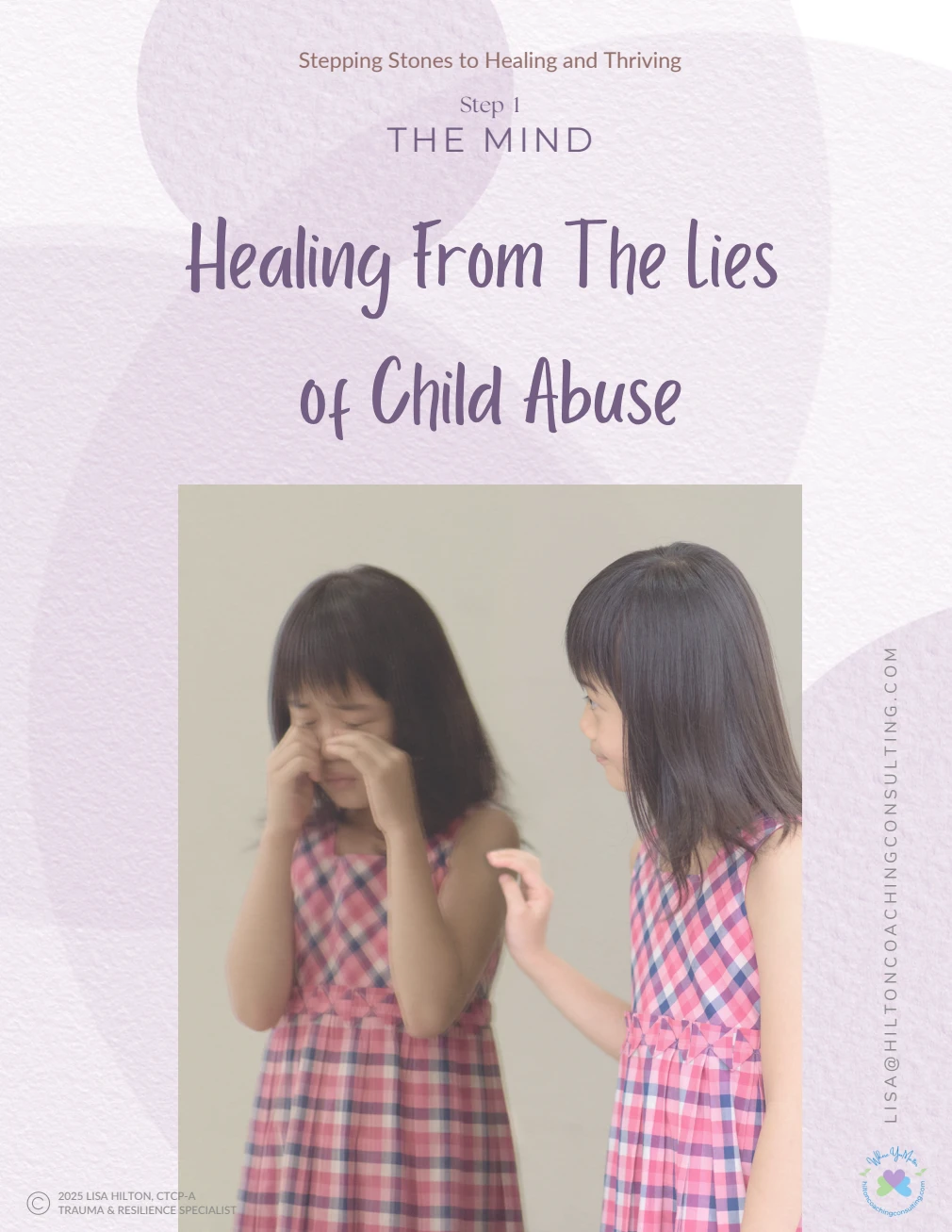
Healing From the Lies of Child Abuse
Step 1 of Lisa’s Stepping Stones program explores the beliefs childhood abuse can leave behind. The workbook offers reflection prompts, space to journal and practical strategies.
See the cover, a reflection exercise and a journaling page from the original workbook. Explore at your own pace.
Workbooks and the guided program are included with Brilliance and Diamond. This original Step 1 workbook is also publicly available.
Find my learning membership↗A PERSON BEFORE A PLAN
Hear Lisa.
Get a feel for the person.
Choosing support starts with connection.
In “Two Years into Healing,” Lisa reflects on her own trauma healing journey. Hear her perspective in her own words before deciding on your next step.
Watch on Vimeo↗Published in Lisa’s resource library. If the player cannot load, use the Vimeo link above.