Before we get started 😊 —Let’s be clear on the meaning of various words.
Siblings are identified as full siblings, half-siblings, step-siblings, foster siblings, cousins, and anyone who lives with or is an integral part of the family of origin.
Abuse is defined as cruel or violent treatment.
WHO’s (World Health Organization) definition of Violence-
“the intentional use of physical force or power, threatened or actual, against oneself, another person, or against a group or community, that either result in or has a high likelihood of resulting in injury, death, psychological harm, maldevelopment, or deprivation.”
Some things about memories –
-
- Each family member will have their own memories from childhood. This blog is based on mine.
- Neuroscience shows that specific memories of traumatic events stay with the individual; they are static – they do not morph over time, nor are they influenced like other memories.
- Traumatic memories are not only in pictures; sometimes, they manifest as emotional flashbacks held in the nervous system. [Peter Levine, Traumatic Memory; Bessel van der Kolk, The Body Keeps the Score]
This blog aims to affirm how common sibling abuse is (easily mislabeled as sibling rivalry) so that others who’ve experienced similar things can identify what happened to them and appreciate they are not alone. It is not about finger-pointing or shaming certain individuals. (If reading this is upsetting or triggering, then perhaps take some time to look inward and find out what’s going on inside – what’s behind it and reach out for mental health or emotional support.)
It is important to appreciate that what is considered harmful, traumatic, etc., must come from the one who received the action, not the perpetrator of them. It’s the receiver who has been severely impacted physically, emotionally, and spiritually, not the other way around. Neither the perpetrator nor anyone else has the right to define what is abusive or causes trauma.
Nobody wants to believe that what they went through is called “abuse” or that it came from their own flesh and blood, nor that they were complicit or participated in it. It is a very hard pill to swallow. No one wants to believe “this” happened in their family. No one wants to see themselves as an abusive person. In some families, the behaviour that caused trauma may not have been intentional or malicious. Regardless, there was an intent to make the action, and the receiver was greatly wounded. And this is what the focus must be on.
From birth onward, children need plenty of emotional support so they can return to homeostasis – the feeling of safety and security — following (a) terrifying event(s). Incidents or circumstances become traumatic when sufficient comfort and consolation are not provided. Babies, toddlers, and young children cannot comfort themselves healthfully without being taught or shown how. This emotional neglect, while perhaps unintentional, causes further wounding. It contributes to the formation of Developmental and or Complex Trauma.
Some Traumatizing Experiences
I endured life-changing events by the time I was seven years old. I was physically hurt (pushed, resulting in a broken foot, lye blown into my eyes), terrorized (hung upside down out a 2nd story window), sexually abused, and objectified – by “siblings”, individuals living under the same roof.
We all know that kids “pick on each other and name-call” from time to time. But when there is a request for the mistreatment to stop, and it doesn’t – it becomes abusive; when there is a sense of power over another – it becomes abusive. I was nicknamed after a dog for years, and my request that it stop wasn’t respected; it was purposely demeaning. I was punched in the arms until they went limp. Again, my requests were ignored. I was told I was making a big deal out of nothing. Clearly, my feelings didn’t matter. Growing up and living in a disrespectful and “unsafe” environment made living too painful. I hated my life. No wonder I attempted to end it when I was 15! Life sucked!
Jumping ahead about 13/14 years, D. and I confronted the sibling who sexually assaulted me. He said he remembered. He looked at me and said, I can’t believe you’re still upset over this. Then he went on to tell me about hanging me outside a second-story window. (I would have been around 2-3 years old when he did that) There are no words for such ignorant callousness. The other sibling who sexually abused me has since passed away.
Were these acts intentional? Yes, each sibling made a choice to initiate. Were they intended to cause harm? I don’t know, and does it really matter? What I know is that what I experienced caused indescribable suffering and undeserving harm. These behaviours weren’t a joke. None of this was harmless fun, or painless. They all caused trauma. To this day, I suffer ill effects from them.
A few years back (2018), the abuser-brother (window, sexual) out of the blue asked me if I had been talking to people about what he did to me. He then started to religiously (using misapplied scripture to guilt-trip and control) abuse. He wanted me to be silent and to control the narrative (aka post-abuse grooming). Interestingly, he didn’t deny…. then.
A New Form of Abuse
Within days of that last incident, I went to the police to have what he did documented. (It was there that the constable said his behaviour was called Sexual Assault. Until then, I thought it was “molestation”). He didn’t deny it when the constable spoke with him, and he didn’t deny it in emails to me. Several months later, I disclosed the sexual assault to the rest of my biological family. Shortly after this, when they asked him about it, suddenly he couldn’t remember. Selective amnesia and denial became his new form of abuse and manipulation. The support I hoped for didn’t happen. Instead, there’s been lying, emotional abandonment, judgment, willful ignorance, and DARVO behaviour. I have been told right to my face that what I feel is not true, that I am exaggerating, that I am twisting things around, and that I am blowing things out of proportion – all of which are gaslighting, deflection, and projection. I’ve been scapegoated. This sibling wrote in classic DARVO speak, why should I have to pay the rest of my life for one non-malicious act? I think, really? There are no words.
Sexual abuse alone is life-altering. Another layer of trauma is added when it’s from a sibling, causing deeper pain, confusion, and suffering. Boundaries are crossed. If the sexual abuse comes with physical and emotional abuse too, more psychological and emotional injuries result. Then, if/when the survivor tells what happened, and the abuser and those he’s influenced do the DARVO dance, there’s even further wounding. The amount of trauma generated is immeasurable, and it isn’t just the victim who suffers – the victim’s children and partner suffer too.
The Impact
Within weeks of the 2018 incident, the allostatic load of all this trauma and more led to a serious health crisis. Life as I knew it stopped. It became apparent my healing journey involves healing from Developmental Trauma, Complex Trauma, and PTSD. My children need healing and comfort too. They along with my husband have “paid” a great price.
In Conclusion:
Secrets are a devastating weight for a little girl to carry. For fifty years I carried it, protecting my family of origin from the truth. The thing is – these were never my secrets to keep. It was never my job to protect. I should have been the one protected, kept safe. Abuse teaches lies about who you are, the world, and your place in it. These then impact health and well-being, and relationships long-term. It takes years to recover. Make no mistake, the sibling sexual assault has ripple effects. The minute he touched me, the dysfunction was evident.
Today, I am not angry at those who caused trauma. I know they were minors too, kids. I don’t see most of them as abusive people – I can easily separate a person from behaviour. I’ve “let go” of the hurt sustained from the choices they made back then. However, as adults today, I look for emotional maturity – ownership and accountability, honesty, humility, compassion, remorse, and a willingness to have difficult conversations. Without these, there is a weak foundation for relationship repair. I will no longer pretend that traumatizing things didn’t happen to me so that others can stay living in “make-believe”.
Truth: Globally, one in twenty kids is sexually abused by a sibling – that’s one in every classroom. Minors sexually abusing minors is the most common form of sexual abuse. The numbers will only increase with access to porn at younger ages now, including sibling porn. Unfortunately, sibling abuse has been hidden or considered harmless “kids-will-be-kids” behaviour for far too long, and society is reaping what it has sown.
Truth: Siblings do abuse.
Not talking about the elephant in the room keeps the toxic shame and disconnection alive. Secrets literally make you sick. Transparency heals.
If you or someone you know endured sibling sexual abuse or is a perpetrator, here are some online resources to explore, 5Waves and Sibling Sexual Trauma. These provide education, statistics, and support for all family members.
As a Certified Trauma Recovery Coach, I’m here too, offering support and a safe space. Your healing journey begins when you’re ready.
Lisa Hilton, CTRC-A
Why do I blog? Well, the short answer is because it is part of what I need to do to heal from childhood trauma. Telling is healing.
There is also a need to use my voice. Not sure how, but I got the message in my life that what I have to say is not important. It could have stemmed from the abuse itself, or a combination of things. Regardless, the only place where I felt listened to was at the religious meetings I attended.
Now that I have developed some self-worth and gotten rid of a lot of unwarranted shame, it is easier for me to be in a group and speak up. However, it is still not super easy for me – not like water running off a duck’s back. It takes conscious effort for an introvert like me to behave as an extrovert from time to time.
Some of the childhood trauma impacted the way I can regulate my emotions and how I think on my feet. Writing my thoughts and feelings down makes it better for me to process things and figure things out as the words are being released through my fingers. I am able to edit, backspace and rethink my words.
Many abuse survivors feel voiceless and powerless. By choosing to put my feelings, thoughts, and experiences onto paper, hopefully, this can be an avenue for those who haven’t found their voice yet.
Validation is necessary for trauma recovery. Writing of my experiences and about what I’ve learned in my own healing journey provides needed validation – for me and hopefully, the readers.
Not everything I share is a personal experience. Sometimes it’s about what I’ve learned and researched. Sharing what has been learned is important to me. Sharing is caring. 😊
There may be vernacular that is not understood by the reader. If this is the case with you, please feel free to look the word up to ensure it is understood in the proper context. Some words mean different things to different people. If in doubt, please ask. 😊
My blogs are my opinions and if any of them cause a reaction inside of you, I suggest getting curious and asking yourself why. Triggers are a good thing. They reveal what needs more work. There is no shame-throwing intended. That is not my thing. If there is some shame that has arisen or anger or embarrassment, then please dig deep and find out where this is coming from inside you. Old habits die hard so it takes concerted effort to figure oneself out, process feelings, detox from them and then let them go. Healing takes courage.
I love what Winston Churchill said: It takes courage to stand up and speak. It takes courage to sit down and listen. And if we’re self aware – we know this is truth.
As I follow my trauma recovery journey I’ve come to see that I had control issues with certain people, and I think it showed up a lot in raising my sons.
I was scared nearly all the time. Not long after I was pregnant with my second son, my husband became unemployed. We had to relocate to a more affordable city and relinquish our mini van to the bank. We couldn’t afford the payments. Life became very ….. unsure….And the ability to trust became even weaker.
I always wanted to be a good, attentive and hands-on mom. I had envisioned how I’d be, how I’d show up, how much I’d engage and be attentive, be positive and encouraging and help them grow, blossom and reach their full potential.
Little did I know….. Little did I know…..little did I know how much my childhood experiences did and would impact me in how I’d mother my sons.
I didn’t trust myself so how could I trust others. I was the helicopter parent at times and other times I didn’t have the language to speak about things without becoming hard-lined, stubborn and even bullying. As they got older and especially after we took in a niece and nephew that went into foster care….that I could see that I no longer could balance it all. I felt I was doing it on my own…. Because I hadn’t learned how to ask for help without it coming back to bite me. It seemed the harder I tried, the more things- the important things- slipped through my fingers. I didn’t feel safe enough to ask for help or accept some help graciously. And I didn’t really know that I needed help with my childhood trauma symptoms that were causing me to unravel.
Child abuse and neglect taught me to just buckle up, work hard, do whatever you can to make others happy and make sacrifices. I was pretty good at Fawning.
There were several inner critics that scolded me and criticized me for not being and doing better.
And this harshness transferred onto my sons at times, when I was totally overwhelmed and didn’t know it. I know I did the best I knew how. I was a good cook and learned how to work hard and manage a house fairly successfully.
Years later….
Thankfully, as I’ve healed, I’ve gotten much more gentle, compassionate, and understanding with myself and this shows up now in social interactions and my interpersonal skills.
It’s OK if people look at things, life, etc., differently than me. It’s OK to “hand the reigns over” and let others choose and take the lead. Now I can trust myself and others a lot more than I ever have.
It feels so freeing! I didn’t realize that by not trusting I was carrying so much unnecessary worry and self judgement!
It’s OK to make mistakes. It’s OK to fail. It’s OK because everyone does, so I’m not unusually damaged, defective or bad– all lies the abuse and neglect told me. Actually I’m pretty normal.
I’ve learned that it’s “healthy’ to not control so much. Hand things over to others, when possible, and things WILL work out as they should.
And I have two amazing sons (men) who’ve married well. They are thoughtful, kind and care about others.
I guess I did a pretty good job overall.
Am I broken?
Childhood trauma survivors usually wonder this because they feel so shattered from the pain they endure(d). This pain is so overwhelming that to exist they must disconnect from it to carry on with life. As a result, they feel like they don’t belong anywhere; they feel lost and alone; they feel unsafe, not knowing who they are. They sense the disconnectedness but don’t know why, where it comes from, or what to do about it.
I have felt this way for as long as I can remember. Only recently have I noticed more shifts happening within, and I am beginning to feel an alignment or unification of sorts inside. It is like the pieces of me are coming together and making up a whole – a new healed me. It is now four and a half years since I was re-traumatized and developed PTSD on top of dealing with pre-existing Complex/Developmental Trauma. Yes, over four years of painful yet rewarding work.
Thankfully, curiosity is replacing the self judgement and I am firm in supporting my need to feel safe. Therefore, I choose to be with those who build me up, who value me and respect me. They help me see my worth and support me to reach my goals. They see how far I’ve come and continue to support me as I heal. These are “my people, my family.”
Three memories emerged recently that overwhelmed me to the point where the executive function part of my brain was inaccessible. First, waves of horrific emotions overwhelmed me. I sobbed and felt like a terrified and helpless little girl. Then I recalled something that was said when I was growing up. I heard more than once that if I didn’t listen and pay attention and do as I was told that I’d die at Armageddon. If I wasn’t obedient, I’d die. If I didn’t listen, I’d die.
Then within seconds two more memories emerged. One was when I was on a road trip, probably a tween at the time, and we stopped at a highway rest stop to use the facilities. I remember while in the restroom thinking: “What if, when I came out, they aren’t there?” And sure enough, when I walked out, I looked for the vehicle and it wasn’t there! A feeling of panic, terror and abandonment hit me like a ton of bricks. I looked around thinking “Who can I ask for help?” and then I remembered the “stranger danger” indoctrination I received. So, I looked for a place to sit down for I was frozen and stuck. I waited. Eventually I told myself, “They’ll come back for me” and they did. Now I don’t know if my pre-existing fear made it so that I couldn’t see the vehicle or what. All I know is that the feeling of abandonment was real, intense and traumatic. It only took a second for me to numb out and shut down my feelings. The panic and terror were too much. So, did this happen because I didn’t “listen”? What did I misunderstand? What did I get wrong? I learned from this experience that if I didn’t listen, my life was in peril.
The other was from when I was in grade seven. I distinctly remember not understanding what a new teacher was saying to our class. The next thing I knew, all the students got up and left and I didn’t understand what was happening. I had a meltdown. I felt absolutely terrified at being left behind. I was embarrassed and felt so ashamed of myself that I couldn’t “keep it together.”
Wow!
Many religions preach that “being bad” would result in going to the “bad place” — a life in hellfire. Talk about spiritual abuse creating trauma – religious trauma! Saying these things either directly to or within earshot of an impressionable child is thoughtless and cruel. It is emotionally and psychologically damaging.
No wonder I go into extreme panic if I don’t understand something, especially when I’m trying to follow directions to something new. These situations are a “do or die” thing to me. This explains my insatiable need to know, to learn, and to understand. As a result, I became a voracious learner. And it explains the harsh self-criticism that came with that — the thinking there was something wrong with me if I didn’t understand something.
Of course, I was going to make mistakes while growing up. Who wouldn’t? But to have these terrifying words put onto the shoulders of a 3-, 4- or 5-year-old?! Shame on that adult!
When we are impressionable little ones, words and events like this crush. They devastate, they wound very deeply. They impact our world view and how we relate to others – to everyone — and to ourselves.
This is why my trauma recovery involves more than recovering from the sexual abuse and the sibling abuse. It also includes healing from the emotional abuse and emotional neglect that I experienced. I grew up feeling so alone, that there was no one in my corner.
For most survivors, childhood trauma comes from a constellation of horrible events. It is rarely from one catastrophic event. The trauma (wounding) results more from the lack of emotional support (comfort and reassurance of safety) that should follow the terrifying situation/event. Reassurance would help the baby or child to calm down and “get back to normal” (homeostasis) afterwards. This is why trauma recovery takes time, love, safety, patience, and self-forgiveness. There is lots to acknowledge, unpack, process, and detox from.
Trauma recovery requires meeting the need to feel safe. And part of it involves overcoming strongly entrenched false beliefs and making and adopting new truths. This is how our minds are transformed – how we make new neural pathways that will serve us for the good. Amazingly after all this, I have a healthy relationship with God and feel very close to Him and loved by Him.
Besides the above, my healing involves connecting with the wounded parts of me — the emotional parts that I couldn’t let myself feel so I could survive. Now, I get to hug these parts, welcome them, assure them that they are believed. I speak to them with compassion, unconditional love, and acceptance. I feel their pain and want to listen, validate, and assure them that I’m there to help them with their burdens of rejection, fear, betrayal, unlovableness, unworthiness, the “not good enough” feelings, and more. I get to be the one who nurtures, loves, and accepts them as they are. This is such a priviledge.
Adults who’ve experienced child abuse and or neglect – I say to you: “There IS hope. You / We can recover. No dear one, you’re not broken, not in the way you think you are. You just need to gently get reacquainted with the emotional pieces of you that are circling around. You can do this and I can show you how.
If you’d like to reach out for support in your own healing journey and see if Trauma Recovery Coaching is the best next step you, please read the blog, Is Trauma Recovery Coaching Right for You, and follow the suggestion at the end.
I am Lisa Hilton, an Advanced Certified Trauma Recovery Coach supporting adult survivors of childhood trauma transform travesty into triumph. It would be an honour to walk with you on this journey.
Breaking Free! You know that brand new skin that shows up after the scab comes off? The skin that is tender still, is pink, and hasn’t been exposed to light and life?
Well, this is how I feel right now. I feel fresh, yet tender. During these last couple of months, I have been shedding some “scabs”; I’ve been processing and detoxing from limiting beliefs and feelings that have held me captive for most of my existence.
Last week was the most remarkable. I finally could allow the love and concern of a certain friend to seep in and soak into my heart. This heart of mine has been yearning for acceptance, respect, and support for so long. It’s learning to trust. In the past when this “offering” was presented, I could not see it; I could not trust it; I could not believe it was true. So, the awkwardness of the wounded parts took over.
Sometimes they dismissed the words, ignored them or responded with cheekiness or sarcasm – all because we (they and I) didn’t know what love and respect looked and felt like. Even today, being treated nicely can disarm me. When this happens, sometimes I shed tears, not understanding why being shown kindness feels scary. Being shown love, care, and respect is supposed to be a good thing, right? Clearly, parts of me have been deeply wounded and haven’t trusted love and acceptance.
I never felt I belonged…… anywhere. It’s awful, sheer agony, growing up in a large family and not feeling that I belong. Even in my marriage, even as a mother…. Doubt and insecurities were all I know. Growing up I was reminded when I made mistakes, I felt the sting of the punishment on the backs of my legs for days; I felt the shame of never being good enough, the shame of being a girl who had no idea how to navigate a world that was scary, unsafe, while learning how to judge and criticize, and about emotional constipation.
Somehow this was my fault and the heaviness of shame, and all its choking power consumed my life. It was with me wherever I went. It showed up in sleep overs, in girlfriend secret-sharing, every time I looked in the mirror, and even in the kindness of others – I just didn’t know how to behave and receive goodness with grace. I was told to not think too much of myself, to not let a compliment make me have a swelled head. I pictured myself walking around with an enlarged head, sticking out like a sore thumb, being a target for further ridicule and shaming speech—feeling even more awkward and targeted.
I learned to hold myself back, to keep myself small. I learned to doubt my thoughts and dreams. I doubted me to the core. There is no way the nice things people said about me could be true. They don’t know the real me!
Really, how sad is that – that a little girl had to learn how to armor up and lie to herself about her worth because her world was so unsafe!
This past week, this wounded part of me was able to come up to the surface with kindness and gentleness, revealing its scabs. It was ready and able to sluff off the old and crusty. The pink and tender parts of me are now here. While scary and unsure, this gives me hope and energy and underscores a deeply hidden belief that I am worthy. I could say last evening to my husband that for the first time I felt like I belonged “here”. Previously I felt I belonged to me, as reclaiming myself is another layer to trauma recovery. Yesterday this is different – a new, more unshakable feeling.
I am still in uncharted waters as I write this, but it feels good enough (safe enough) and I’m willing to be courageous enough to move forward. To have hope regarding my trauma recovery is a blessing. My faith has something to do with this, for sure. Yet this new feeling is more than that.
Being able to taste the freedom that comes with losing the shackles that collude with child abuse and emotional neglect is amazing! As each layer of lies is shed the more authentic I become. This is liberating. I can see now that I am respected and it feels good to be here in this place, finally. Soon I will be a published author. I can’t wait!
As I heal, I have the courage to establish and maintain healthy boundaries and no longer have the capacity to hold space for those who disrespect me. To me, disrespect manifests as name calling, character mislabeling, a refusal to listen to what I have to say, as judgement, as close mindedness, as willful ignorance, and an unwillingness to prove you are safe and trustworthy.
Inner peace and safety are more important to me than ever before.
Lisa Hilton is an Advanced Certified Trauma Recovery Coach, supporting adult survivors of childhood trauma transform their travesty into triumph. Feel free to contact her when you’re ready to take the next step in your own childhood trauma recovery.
What is my worth? This is a HARD question. And for a childhood trauma survivor it can shut you down, completely, just contemplating it. Why?
Because we don’t see nor feel that we have any worth. We learned through experiences – a look, a hit, words, sighs, eye rolling, tattling, assaults, etc., that we are NOT accepted for who we are.
By the time I was 3 years old, my nervous system already had a felt sense that I wasn’t wanted nor appreciated. I had already felt terrorized on a couple occasions. My nervous system was on high alert because I didn’t feel safe.
So how does a wee one cope?
What I did was work hard at being useful. I learned how to help mommy cook and clean. When I did these well, I received a smile, a thank you and a little praise. Only then did I feel loved. This taught me that I had to “do” to “earn” love, acceptance and appreciation.
The next 5 decades I gave too much power to what others thought of me. I could NOT see nor accept that others liked me simply for being me for I had learned a different truth – that I was unlikable/unlovable. I had built a wall around my heart for self-protection and self-preservation, and nothing could penetrate it. I disconnected from my emotions, and this caused me to disconnect from myself. I didn’t know who I was for the longest time.
Over time I had become skilled at wearing a *mask* and the pretending, the keeping of a secret [that I was sexually abused] was exhausting. I felt challenged socially, always nervous around people, uncomfortable with small talk. I believed there was something wrong with me.
Not until after I started my trauma recovery did I learned how to let love in….. s l o w l y.
It took a LOT of mental reprogramming, to let the armor down. I started with letting God’s love in. THAT alone took a LOT of work. I didn’t know at that time how much the denial of my experiences and pain, the gaslighting, the criticism, the emotional abandonment and weaponizing of scripture impacted my view of self and the world. I had to deal with the loss and the grief that came with that realization first before I could understand why my heart ached and pined for certain relationships that were toxic, just to have a sense of *belonging and acceptance*.
I was looking for love, acceptance and understanding externally but what I needed was to support my nervous system and learn to love and accept myself.
As I said at the outset, this week I finally made the connection to what was obscurely behind it all — the deep-rooted yearning to be liked. Ooooooo, putting this out there is scary!
Now I understand that unbeknownst to me, all along, deep, deep inside I was compelled for decades to focus on being helpful, useful, supportive of others – to be the Go-To person in time of crisis and despair. I took pride in being called at all hours to help a friend in crisis. I needed to be needed. All which came at a cost to my physical and emotional health. This is called Fawning, a trauma response, also known as co-dependency.
[Can you relate to this? Are you one of those people that jump in quickly to help others? Who sacrifice so much to be there and end up depleting yourself or getting hurt in the long run? …… I’ve been there way too often.]
To finally make this connection – Oh how SWEET! To realize that behind it was a lie – the belief I was not appreciated/liked and how this created a desperation for wanting to be valued – how vulnerable to admit this!
I developed a tough, capable, and competent veneer. I was smart in school [A- average] and loved learning. I was curious, wanted to know how to do things and take care of myself. I learned to not rely on anyone for life’s basic challenges – was fiercely independent. Admitting this here is hard to do. Seeing it in print is difficult yet healing and validating.
So, learning to love me and appreciate me is what eventually opened the lock to this vault. I’m smiling because this makes me happy to see another door opened for me in my own trauma recovery. I can see AND feel my own worth now!!!! It doesn’t matter if people like/accept me or not. My worth is not defined by others, at all.
As an adult childhood trauma survivor do you see similar patterns or mindsets in yourself? If so, you are not alone.
Lisa B Hilton is a Certified Trauma Recovery Coach, supporting adult survivors of childhood and developmental trauma Transform Travesty into Triumph.
What is Normal for you?
One thing that has become clear as I continue in my education and trauma recovery coaching is that only after an individual decides to begin healing were they able to face the facts that their childhood was worse than thought. In fact, many start off the bat stating that they’ve had great childhoods and had awesome parents. The rush to defend the parents is strong.
I wonder…. If the childhood was so great, Why the struggles now in adulthood?
This is what I see happens……
Usually after something or a series of events the rose-coloured glasses lose their power.
Only then it’s noticed there has been a lot of dysfunctions. Perhaps in the family of origin [FOO] it’s noticed that there wasn’t a lot of healthy communication, or there was unwarranted violence or anger, there was neglect [physical and or emotional], chaos, drugs/alcohol abuse, parentification of child/ren, or other forms of abuse/neglect, and more.
Growing up in environments like this, the child only sees this as normal. It’s what they know; it’s normal to them so they don’t talk about it. They learn to not complain [others have it worse], to keep secrets – it’s the don’t ask-don’t tell rule. If there is emotional or psychological abuse happening then the child/ren learn that what happens is their fault, of if they do tell someone, the family will be split, and again, that’d be their fault.
This lack or inability to be open and honest in communication, the keeping of secrets, the shame – these become part of how these ones’ roll. This is the way life is supposed to be, right? Don’t all families have dysfunction so why should I *make a big deal out of mine*? That sounds like self-gaslighting language to me.
The damage and pain this environment cause is way too heavy for a little one to shoulder son in order to cope the child feels the need to pretend that all is fine, or they turn off their feelings all together and become numb or disengaged. This becomes *normal*.
Something’s gotta give, eventually, right?
Down the road what gives can be health, physical or emotional. Why? Because all childhood / developmental trauma is stored in the body. Eventually things will surface either in flashbacks or physical pain and suffering.
Yet the reluctancy to admit that homelife wasn’t all that healthy is hard. There is the struggle with seeing self as disloyal. After all, didn’t our parents do the best they could?
Why does it have to be either or? Can’t both be true? That parents did the best they could and the home environment wasn’t the best? Perhaps that is true in your case? Perhaps it wasn’t.
True, all would like to look back and see there was a good childhood with happy memories, where parents were able to meet their children’s needs and they felt attached and close. Most want to believe their siblings and family environment was good. The alternative reality is too much for many to accept. So, some fantasize. Others remain fully aware of the circumstances they find themselves in as a kid. Either way deep damage ensues.
Parents aren’t given the responsibility to just keep their children alive. Their responsibility is to support their child/ren to become the best version of themselves – to blossom and thrive. Parents need to nurture, protect, and guide their children. This is their child/ren’s birthright.
We cannot dismiss the need for a child, every child to grow up feeling safe, loved unconditionally, and wanted. These needs must be met and they are equally important as food, clothing and shelter.
If you didn’t have that kind of upbringing then chances are you have struggles.
And that is OK.
The first step in trauma recovery is awareness. It happens when you acknowledge what happened to you in childhood. It is crucial to name it. Only then can healing and repair happen. You cannot heal what you do not acknowledge. This step is perhaps the biggest hurdle for some.
And this creates another paradox. Because you then can feel torn and negatively judge yourself, thinking that it is selfish and ungrateful to want more – from life and from family. [more self-gaslighting]
And it is important to restate this truth – healing from childhood trauma is NOT about blaming the parent(s) or the sibling(s) or anything like that. Trauma recovery is about acknowledging the truth – what happened. Full stop. If any family feels that you’re blaming them for what happened to you, this means they are carrying their own shame.
Their shame is not yours to carry.
Their secrets are not for you to carry.
The body already knows what it has experienced since conception. Pretending, making self think happy thoughts, focusing only on the positive — all lead to a life of constant disconnection. Therefore, New Age thinking is toxic. Handling life like this is Not sustainable, nor is it healthy. It forces you to live in denial. Medical and scientific facts show it is better to see life realistically. Life is richer when we take note and are attuned to the great times and the not so great. Admitting to what is, is best. Life is not some fairy tale. Life is full of triumphs and travesties, times of sheer joy and deep grief and perhaps even betrayal.
Let me ask again, What is your Normal?
When you are ready to do the work of addressing the challenges that stem from adverse childhood experiences and want support to gain healthy coping strategies, I’m here.
You are not alone.
Lisa B Hilton is a Certified Trauma Recovery Coach, supporting adult survivors of childhood trauma and neglect transform their travesty into triumph, whereby they can live life in freedom and authenticity.
Time to say Goodbye
For the last few months – since the middle of May – LOSS as been camped at my doorstep.
It was then that we decided to sell our little home. This decision wasn’t taken lightly. It was to be our forever home. When we moved in, we told ourselves that this was it: we were going to have to go out feet first. That was the plan when we purchased and plans sometimes have to change.
Just a year after we purchased, life took a very sharp turn and now four years later, it is time to say goodbye and move forward. While this decision is a good decision and the right one to make at this time, that doesn’t mean there isn’t sadness, a loss, that I am experiencing.
Next week we start packing and moving into our new place. August 20th will the day of the move for all the big items and we’ve hired a moving company to do this.
Then we will do the final clean before we hand over our keys to the new owner. We hope she comes to loves this place as much as we do. I spent hours with graph paper designing our dream kitchen so my heart and soul were put into this little home.
It is soon time to say goodbye.
And with all this, our elderly cat, Sir Igby, is showing signs of dementia. It seems to be getting worse, and we wonder how long…. Our hearts are aching as we know we’ll have to say goodbye to him we fear sooner that we had planned. He has an appointment this Friday with his vet to ascertain what is truly wrong with him and what the prognosis is. He is at lest 16 years old.
All I can see and feel is Loss right now. It is hard to think, to concentrate, to work. I sigh and shed tears and let the pain in. This month is a tough month and it’s only the 8th.
Loss and grieving is a big part of healing from childhood trauma. I haven’t gone backwards in my healing, I’m now uncovering another layer of sadness and feeling the loss of so much. Each time I didn’t grieve enough previously …. I’ve noticed that it builds up so when there is another loss, it seems that the sadness is disproportionate. Then the self judgment comes out. The negative and critical self talk, right?
That is not the case this time, fortunately. I know there is a lot of sadness inside and if this move brings some of it to the surface then let the detox begin! It’s Ok to cry. And It’s OK to watch someone cry and feel helpless. The thing is, we aren’t responsible for someone else’s feelings, including their sadness and their joy. No one specific caused what I’m feeling. My feelings are just there and that’s perfectly fine.
The best thing we can do is sit with a person in their sadness and just hold space for them. That’s all. And we can sit in our own sadness and hold space for ourselves. The nervous system needs acknowledgement of what it’s experiencing. Denial causes disconnection which is the opposite of authenticity
Feeling sad is authentic. Mourning is authenticity in action. And without the mourning, the releasing of the grief, then authentic joy and happiness cannot move in the open space that the grieving leaves.
Authenticity means experiencing emotions as they happen. It means being present to feel, taste, touch, hear, see and sense; it is where and when we feel truly alive.
This is the hope and goal of adult survivors of childhood trauma. We need to feel the emotions so these can be released. It is not fun nor easy but necessary to come out the other side.
And if that means having minutes, hours, days, times, seasons of sadness or righteous rage, or indignation, hurt, feeling betrayed or abandoned, etc, then so be it. We are learning how to feel emotion like an infant and it takes time and practice to get it where it’s not so uncomfortable while appropriate for the person/situation. We learn that as adults, we have the tools already, it is just that the nervous system still thinks we’re little.
This is where patience and self compassion step up and are used to heal ourselves. Prayer helps me too. Practicing mindfulness and grounding while noticing my breathing helps.
In Trauma Recovery Coaching we work together to learn/adopt appropriate skills as necessary. Your coping toolbox becomes more robust over time. Together we underscore that this period will pass as I’m right there with you, holding space for as long as you need. You are not alone.
Dear Me,
My dear little Lisa, I am letting you know that you deserved better treatment. You deserved better. You deserved to be held, cuddled, loved, and treated like you have value and appreciation. You deserved to feel unconditional love, to feel accepted, to be acknowledged, to feel adored, to feel appreciated, to experience healthy affection and admiration, to feel approval, to feel that your mother / father / siblings *get you* – that they are attuned to you. You deserved to feel seen and heard.
Instead, you grew up feeling judged, guilty and shamed for being who you are, that you’re not good enough. You grew up feeling responsible for everyone else’s feelings; you contorted yourself so that others wouldn’t feel upset because you always thought it was your fault. You grew up never feeling understood. All this plus the other abuses caused a LOT of damage. What you went through caused so much unnecessary pain and suffering.
It seems your mom was just too busy and distracted with her many responsibilities [she had 6 kids after all!] As you learned later that for many reasons she didn’t have the time nor the wherewithal to be attuned to you and what you desperately needed from her. You ended up feeling and believing you were a nuisance, annoying, in the way, too needy and unloved and especially without value and worth. There was no one there to supply the nurturing you needed. I know you’re not blaming her – she didn’t know better either.
I am so sorry that you felt this way for soooo long, way too long. Too long that it became a core belief and a mindset that deeply impacted your way of being and how you showed up in life. I’m sorry that you felt you had to hide, to play and be small, that you weren’t appreciated for your sparkle and valued for who you are. Instead, you felt ashamed of yourself. You felt guilty for things you did that were symptoms of the complex trauma you were experiencing. You even took on guilt and shame that didn’t belong to you. Your nervous was just too sensitive. I am so sorry that you carried this for all these years, for decades.
You are not the problem. You are not at fault. You deserve to feel unconditional love. You deserve to be and feel supported. And it’s ok and good that you seek out those who will provide this for you. I am here to tell you that your feelings matter.
It’s not your fault that your parents, due to their own childhood experiences, weren’t able to provide the kind of parenting that would have healed you and made you feel safe and protected. I’m sorry that instead you were criticized for making mistakes. Severe punishment would ensue. And that you read it as shame and guilt for just existing. You read it that they were ashamed and embarrassed of you. Your poor nervous system.
Of course with adult wisdom, in looking back you understand it all now. But don’t forget you were a little girl, with little girl needs that weren’t being met. You were trying to navigate a world that had shown itself to be scary and unsafe because of what your brothers had done to you and because your mother wasn’t attuned to your fears, because she wasn’t able to be fully present and console you and assure you of safety and protection. All this piled onto an undeserving little body and a highly sensitive nervous system created your insecurities.
I really feel for you my dear little one.
It wasn’t your fault.
I am so sorry that you experienced this and that now as an adult you must do the work to heal from the scars all this created.
I am here to be with you, to hold you and love you as you never felt. You deserve to feel unconditional love. I know that you need to grieve all this. I’m here to hold you.
Yes, as an adult you understand your parents and see and accept their imperfections. This is good. However, it is important to your healing that you acknowledge how you felt and what you suffered because everyone’s imperfections. And as an adult you’ve acknowledged and own that your unhealed childhood wounds were passed on down to your two sons too. I’m proud of you for healing this much and being self-aware enough. I am proud of you for being as transparent as possible in our healing journey so they too can understand themselves and you better.
It is time to release this unwarranted guilt and remember that all this damage resulted from Adam and Eve’s stupid decision. They passed on this imperfection to their children and on it went down to me and little you.
People don’t know what they don’t know – yet it is each one’s responsibility and obligation to become aware so their toxic behaviour doesn’t keep getting passed onto others.
It wasn’t your fault. Remember that.
It wasn’t your fault.
Your existence matters. God believes you are valuable, that you are worthy. He is there for you and is with you. Please remember where this imperfect and self condemnation comes from – it’s not from Him.
Please keep on letting your light shine. Keep helping fellow childhood trauma survivors see and feel that they are not alone. Please be accepting of yourself and others’ imperfections, knowing that most are trying to do their best. And that there are those who choose denial, who refuse to learn, grow, be open to self awareness – that is on them, not you – these ones be careful of.
Please keep recovering from your childhood trauma so that the detox continues, and the projection stops with you.
I think you’re doing great! So proud of the work you’re doing. It is HARD work and I believe you made the best decision – to heal. The sense of freedom that results is so worth it!
I love you, little Lisa. I am so proud of you. 😊
Lisa B Hilton is an Advanced Certified Trauma Recovery Coach who has lived experience. Through coaching she supports fellow adults transform their travesty into triumph. Please read her blog: Is Trauma Recovery Coaching Right for You? and reach out to her if you feel this modality of Trauma Recovery Coaching will be a good fit for you. Thank you.
Nearly 4 years into doing the really hard work of trauma recovery, this month I’m looking back. It’s like I was a different person then. Still, I remember the emotional pain and all the thoughts and feelings experienced. For example, I recall the frustration because I felt silenced too often in my life. Therefore, during these last 4 years – I strongly felt the need to purge – to just tell and tell and tell again what I went through, sharing how the traumatizations impacted my life and how the absence of empathy from certain ones caused further pain. My silence was over. It was a way to process and name my experiences, which opened the door to healing, for self-acceptance and self-forgiveness.
Clearly this *telling my story* is a normal and necessary part of trauma recovery. Telling gifts the survivor validation. Telling is healing. Survivors of abuse need to talk, they need to self-validate, and they need empathetic witnesses to listen. Being in this place isn’t fun at all. I really had no idea what the road to trauma recovery would look like and be like. There were so many unknowns then. I had faith in neuroplasticity though and that is what kept me moving forward. That’s why now, when I listen to console fellow trauma survivors I say: “I hear you.”
As a recap, with trauma education, lived experience in childhood/developmental trauma and all that comes with it, this following list is some of what I needed to gain clarity on, or adopt, process, understand and if needed, let go of:
|
Advocating
Anxiety
Attunement
Blogging
Counselling/therapy
DARVO
EFT
EMDR
Emotional dysregulation
Healthy pride
IFS modality
|
Emotional Flashbacks
Emotional Intelligence Emotional Literacy
Enabling
FFFF – Fight Flight Freeze Fawn responses
Gaslighting
Grooming
Healthy and toxic shame
Healthy boundaries
|
Inner peace
Listening to understand
Mindfulness
Poly-vagal theory
Receiving and providing Trauma Recovery Coaching and facilitating TRC in 1:1 & Groups
Religious abuse
Scapegoat
Self-acceptance
Self-awareness
|
Self-compassion
Self-love
Self-worth
Social anxiety
Spirituality
Suicidal ideation
Support
Terror
Trauma bonding
Validating
Vlogging
Workshops
|
and more…. I understand myself a whole lot better now and have a more balanced understanding, empathy, and compassion for others and self, plus … a trauma-informed vocabulary. 😊
Childhood Trauma Recovery is an ongoing journey. When ready, the body will bring to the fore some memories to process and detox. This work no longer frightens nor intimidates. The uncomfortable feelings or memories are allowed to be. The more that’s allowed with compassionate curiosity, the faster they leave. I’ve accepted the truth in what we resist persists. Naming what happened makes the trauma lose its power – name it to tame it. What is new now is waking up with emotional flashbacks in the way of dreams. While upsetting I’ve learned to let these feelings exist, appreciate what they’re telling me and understanding this is another way my body is detoxing the trauma.
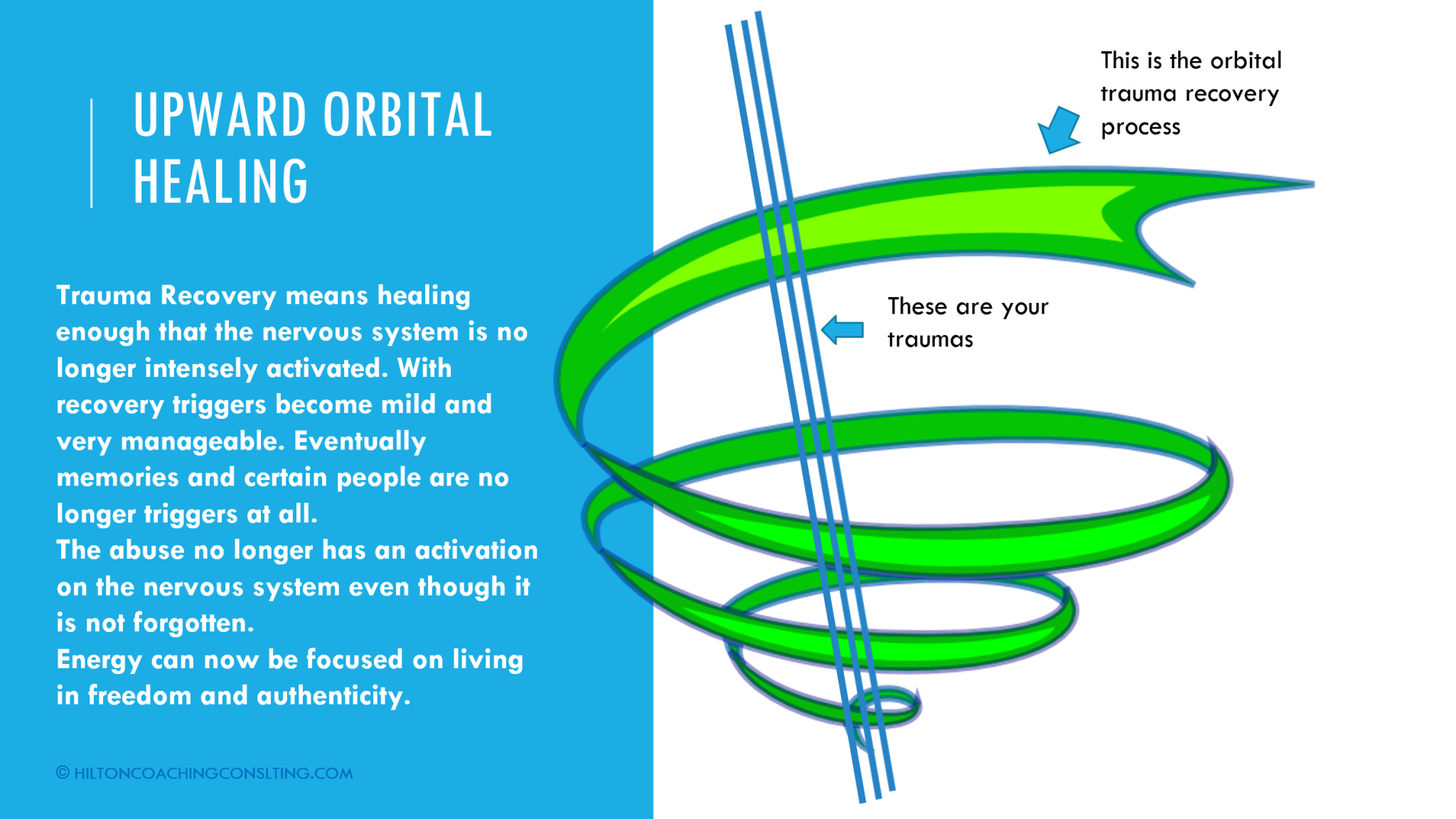
Trauma Recovery Orbit – at the core is / are the traumatizing event[s] and as each orbit takes its turn [life happening] and upsetting situations occur, one may go back to similar old feelings and angst. The cool thing is that one is never back at the original pain level. Each trigger felt becomes less impactful. Over time trauma memories become benign. Life, as we know it, will always present social/emotional challenges. Yet with the nervous system healing, with the brain rewiring itself, blended with healthy loving and safe relationships that provide unconditional love, acceptance and support, these challenges are embraced with greater ease. Homeostasis happens quicker. Between each revisit there is more time. Each spiral orbit is bigger, encompassing more time.
Feelings buried are buried alive. This is Fact. For me, processing memories or feelings involves allowing these to surface and be curious about them. Being still, allowing self to sit with and lean into without judgement – this enables accelerated healing. I assess and determine what the memories are. I pray about it, determine what part of the event[s] are mine and what aren’t, then mentally put the shame onto the shoulders of where it rightfully belongs. I own my part and no more. Here is the Accountability stage. I am now at the place where I openly acknowledge and own my part in decisions made. And this no longer feeds the warped and toxic shame monster who’s been following me around for decades. Thankfully this unwarranted / toxic shame has been kicked down to a manageable size. I have gotten used to being in the ventral vagal place – homeostasis.
I do this processing when pleasant feelings arise too. For instance, I didn’t know what it felt like to feel respected and unconditionally loved so whenever I was praised, complimented, or listened to with respect, this was new to me. In the past none of these niceties landed in my heart, all compliments were quickly dismissed. Healing means I’ve learned to sit with the uncomfortableness of the emotions that admiration and respect evoke – I lean into these emotions and feelings. Doing this builds the healthy neural pathways, thereby supporting the nervous system to get used to new healthier emotions and feelings. In time the sluffing off or dismissing the compliments stop. Thankfully with healing, I learn how to enjoy the feelings of being respected and having self-respect. 😊
Healthy shame was/is behind some good choices too. For instance, I am open to listening to my sons if they want to share what their childhood was like living with me – the behaviours I manifested due to my own unprocessed trauma and while mis-medicated, and all that came with it. It’s painful yet necessary for their own healing. I own my part, I apologize, I listen, cry silently then thank and commend them for their courage to tell. Validation is super important for healing. I have felt the guilt and have apologized. This processing and releasing aids in healing. I recall what it feels like to not receive validation nor witness heartfelt remorse by my perpetrators so I will not do that to others, especially my sons.
Previously, toxic Shame had too much power. I now observe how it impacts others. I see it manifest in so many ways and gone is the urge to explain myself [fight response]. Emotional distance aka healthy boundaries is crucial for my nervous system’s continual healing. While I understand where unhealthy behaviours come from it’s not okay to allow myself to be mistreated – to have others’ shame thrown onto me. I won’t wear it. Healthy Boundaries are super important. Each time I talk to God about it the answer is the same – ‘stay away and let them do their own work; ensure your own peace.’ Shame binds to nearly every feeling if we let it. I refuse to let it have power anymore. And this feels marvelous! Had no idea how liberating it would feel to not carry toxic shame.
This is a big part of the FREEDOM that Trauma Recovery provides. And until I began to have moments of being shackle-free, I had no idea how much life had been lived in chains, had no idea how much I struggled just to survive. I had no idea how much pain I was in nor that shame was usually in the driver’s seat of life. I thought this was normal for everyone. To be able to feel happy emotions and not go into dissociative states is such a triumph. Now THIS is thriving!
Evidence! Recently my eldest son was married. He married overseas and with COVID, it was wiser to be on the Zoom side of the event. To be able to be moved with tears of joy and feel my deep love and pride for him is such a beautiful blessing to experience. To tell him with happy tears how proud I am of him, how much I love him and how happy I am for him was a gift to him and me – he too was moved to tears. I know that a few years ago this couldn’t have happened. To be in the space and place where authenticity and being fully present lives is truly one of the best gifts that trauma recovery has to offer. For those who have never experienced such intense inter and intrapersonal connection, this may sound foreign. Let me say that being able to feel whole within, connected within is something to highly value.
THIS – the authenticity and mindfulness are some of the silver linings that come from all the hard work of self-examination, self-acceptance, leaning into emotions, addressing, learning, transforming, healing, processing, releasing, and gaining confidence – all this has been worth the work. Yes, every single tear, outcry and pain has been worth the effort. I don’t think there is anything more courageous than facing the *demons* of Childhood trauma.
As said in a previous blog, Trauma Recovery is like Emotional Physiotherapy. Childhood Trauma survivors need to learn how to address and accept the traumas [the injuries], develop the right emotional muscles to live life with greater ease, flexibility, movement, and confidence. We need to learn healthful coping strategies for managing whatever lies ahead, instead of doing the avoidance dance. The result? Joy, freedom, authenticity, confidence, connection, healthy relationships, happiness, calm, inner peace, and so much more. Having a peer to peer coaching relationship with a Certified Trauma Recovery Coach [CTRC] provides the right support.
I wish for you, the reader, to continue with your own trauma recovery process. Please don’t give up. The feelings and the amazing life that awaits you is well worth every step taken along the way. You Matter.
If you seek further support in the final leg of your recovery journey, please reach out to me.
I see you, I hear you, I care.